
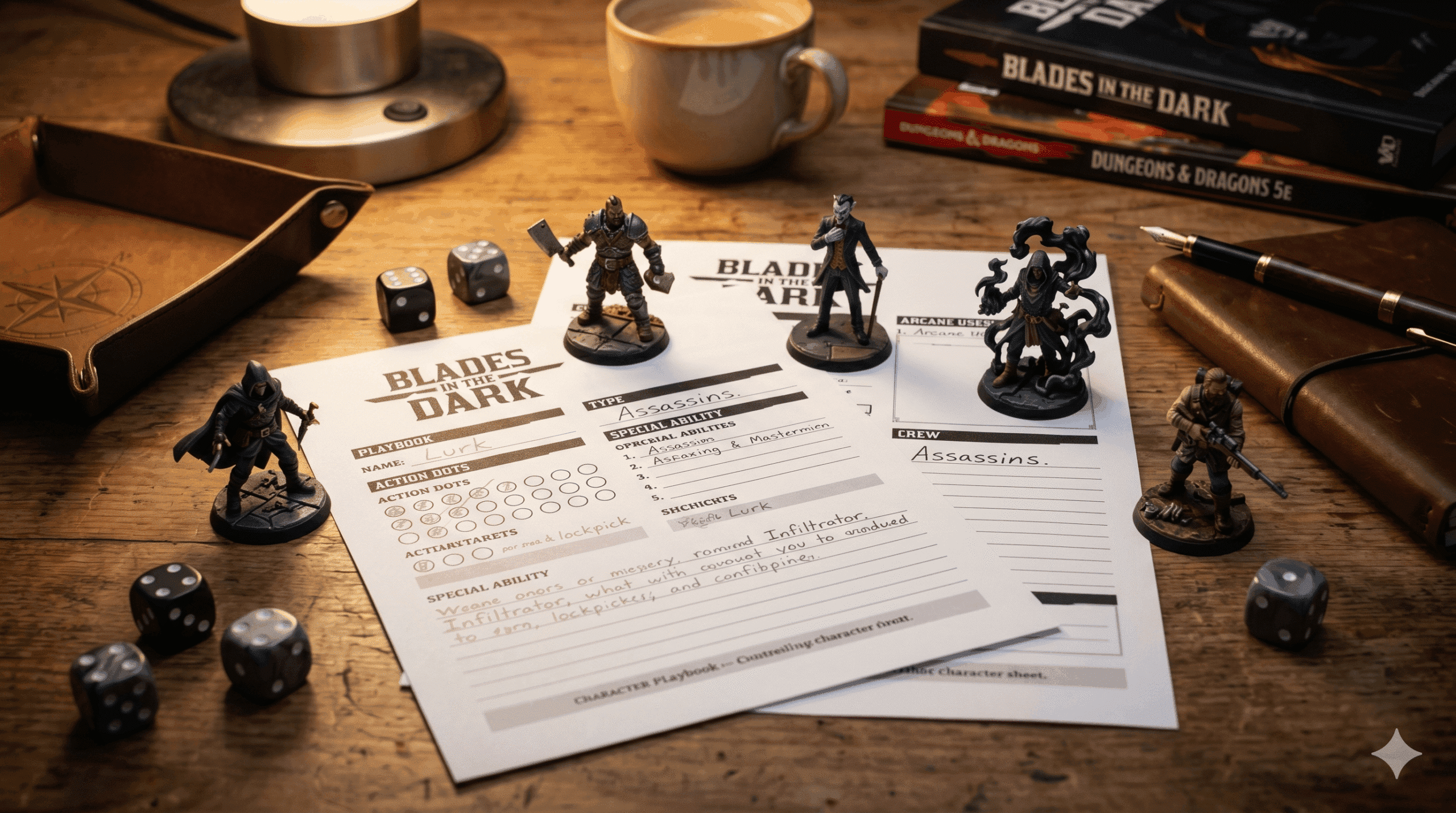
Character creation in Blades in the Dark (BitD) is a collaborative process where players build “scoundrels”—specialized criminals operating in the haunted, industrial city of Doskvol. Unlike the heroic, combat-heavy builds of Dungeons & Dragons, BitD characters are defined by Playbooks (archetypes), Action Dots (versatile skills), and Vices (narrative flaws). The goal is not to build an invincible hero, but a compelling underdog who thrives on risk and cinematic consequences.
Table of Contents
If you are coming from years of Dungeons & Dragons or Pathfinder, your first instinct in a new system is likely to look for a combat meta or a “tank/healer/DPS” balance. In Blades in the Dark, you need to set those instincts aside.
This is a system where the “Crew” is just as important as the individual, and the mechanics are designed to keep the story moving at the pace of a high-stakes heist movie. Here is how you build your first scoundrel.
1. Choosing Your Playbook (The Archetype)
In Blades in the Dark, your “class” is a Playbook. While these look like D&D classes, they are actually sets of narrative “triggers.” Each playbook rewards you with Experience Points (XP) for playing into specific tropes.
| Playbook | The “Vibe” | Why Play This? |
| Cutter | The Enforcer | You want to play a soldier or a vicious thug who solves problems with a blade or fist. |
| Hound | The Tracker | You enjoy being the sharpshooter or the bounty hunter who never loses a trail. |
| Leech | The Saboteur | You like using “weird science,” alchemy, and bombs to bypass obstacles. |
| Lurk | The Infiltrator | You want to be the classic thief—sneaking through skylights and picking locks. |
| Slide | The Manipulator | You prefer talking your way past guards or wearing a disguise to social galas. |
| Spider | The Mastermind | You want to be the one with the plan, the connections, and the backup strategy. |
| Whisper | The Occultist | You want to mess with ghosts, demons, and the terrifying lightning barriers of the city. |
2. Defining Heritage and Background
In Doskvol, where you come from matters.
- Heritage defines your ancestry (like D&D species). Are you a local Akorosian, a “foreign” Iruvian from the desert lands, or a Tycherosi with a demonic physical trait?
- Background defines what you did before the life of crime. A Noble scoundrel plays very differently from a Labour scoundrel, even if they share the same Playbook.
3. Assigning Action Dots
Instead of Strength or Dexterity, Blades in the Dark uses Actions. These represent how you approach a problem. During creation, you assign dots based on your Playbook, Heritage, and Background.
- Prowl: Moving silently or jumping across rooftops.
- Sway: Persuading, lying, or seducing.
- Wreck: Brute force—smashing a door or sabotaging a machine.
- Study: Researching an occult ritual or finding a weakness in a building’s blueprints.
Universal Advice: Don’t worry about “covering all the bases.” In Roleplay Mastery, we often emphasise mechanical optimisation, but in BitD, having a “0” in an action means the consequence of failure will be more interesting.
4. Special Abilities and Contacts
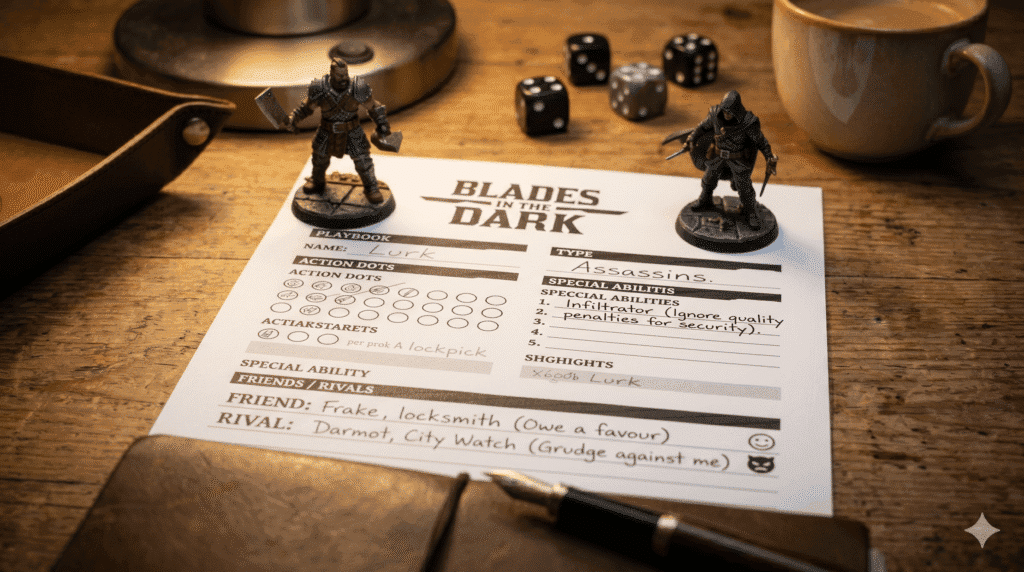
Every Playbook comes with a list of Special Abilities. These are similar to level 1 feats. For example, a Lurk might take Infiltrator, which allows them to ignore quality penalties when bypassing security.
Additionally, you must choose a Friend and a Rival. These are NPCs already established in the book. This ensures that your character is woven into the city’s social fabric from the very start. You don’t just “meet in a tavern”; you already owe the local locksmith a favour, and a specific city guard already has a grudge against you.
5. Managing Stress: The Vice
In BitD, your “Health” is essentially Stress. You spend Stress to push yourself for better rolls or to resist “Harm” (damage). To get that Stress back, your character must indulge in a Vice.
- Does your character gamble at underground dens?
- Do they find relief in “Obligation” by helping an orphanage?
- Do they seek “Stupor” through strange alchemical drugs?
Indulging your Vice is a mandatory part of the game loop. It’s a double-edged sword: if you “overindulge,” you might go missing for a few days or cause trouble for your Crew.
The Mindset Shift: Leaving the Hero Behind
Before you even look at a Playbook, you need to fundamentally rewire how you think about your character. In D&D, you are building a hero destined to save the world. You start weak, but the trajectory is always upward toward godhood. You are expected to win.
In Blades in the Dark, you are building a desperate criminal in a city that actively wants to crush you. You are not a hero; you are a scoundrel. You will get hurt, you will get stressed, and you will make terrible decisions because the mechanics actively reward you for doing so.
If you try to play BitD like D&D—cautiously planning every move to avoid taking damage and hoarding your resources—you will find the game incredibly boring. The system is designed to emulate the chaotic, seat-of-your-pants energy of a heist movie like Ocean’s Eleven or Peaky Blinders. You are supposed to leap before you look, trust that your character is competent enough to handle the fallout, and use the game’s unique “Flashback” mechanic to explain how you planned for this exact disaster all along. Embrace the mess. A scoundrel who never takes a risk is a scoundrel who never earns XP.
The most liberating moment for any D&D veteran transitioning to Blades in the Dark is the first time they roll a “1-3” — a failure with a serious consequence — and realise that the table erupts in laughter and excitement rather than groaning in disappointment. In BitD, failure is not the end of the scene; it is the beginning of a far more interesting one. The game’s entire architecture is built around the principle that a bad roll should always move the story forward, never grind it to a halt. Once you internalise that philosophy, character creation stops feeling like a puzzle to be solved and starts feeling like a story waiting to be told.
The Crew: Your Most Important Character
One of the hardest concepts for D&D veterans to grasp is that in Blades in the Dark, the party itself is a character with its own sheet, its own progression, and its own abilities.
Before you finalise your individual scoundrels, you must sit down as a table and decide what kind of Crew you are running. Are you Assassins taking high-profile contracts? Are you Shadows pulling off silent burglaries? Or are you Hawkers selling illicit alchemical substances on the street corners of Crow’s Foot?
Your choice of Crew dictates the tone of the entire campaign. It also provides your individual characters with shared abilities and a communal pool of resources. If you build a heavily armoured Cutter but the table decides to play a Crew of Shadows, you are going to have a very loud, very awkward time sneaking through skylights. Build the Crew first, then build the scoundrels who would naturally gravitate toward that specific criminal enterprise.
The Power of the Devil’s Bargain
As you build your character and assign your Action Dots, you might feel anxious about having a “0” in a crucial skill like Skirmish or Tinker. In D&D, a low stat is a liability to be avoided. In BitD, a low stat is an invitation for the GM to offer you a Devil’s Bargain.
A Devil’s Bargain is a core mechanic where the GM offers you a bonus die (+1d) on your roll, but in exchange, a negative consequence occurs regardless of whether the roll succeeds or fails. For example, you might be trying to pick a lock with a 0 in Tinker. The GM offers a Devil’s Bargain: “You can have a bonus die, but you leave behind a piece of evidence that the Bluecoats will trace back to your lair.” If you accept, that consequence becomes canon immediately, even if you roll a critical success on the lockpick.
This is why you should not stress about perfectly optimising your Action Dots during character creation. The game provides you with narrative tools to succeed even when your character is mechanically out of their depth. You just have to be willing to pay the price.
The “Flashback” Mechanic: Why Planning is a Trap
If there is one habit D&D players must break when transitioning to Blades in the Dark, it is the endless planning phase. In a traditional fantasy RPG, players will often spend two hours outside a goblin cave debating the optimal entry vector, drawing maps, and casting divination spells. This is because in D&D, once you roll initiative, you are locked into the consequences of your preparation. If you didn’t buy a 10-foot pole in town, you don’t have one when you find the pit trap. Blades in the Dark actively punishes this style of play. The game is designed to emulate the pacing of a heist movie. Think of Ocean’s Eleven: the audience doesn’t watch the crew spend three hours buying blueprints and debating guard rotations. The movie cuts straight to the action — the crew is already inside the vault, the alarms are blaring, and then the film flashes back to show how they prepared for this exact moment.
BitD achieves this through the Flashback mechanic. Instead of planning for every contingency, you choose a “Plan Type” (e.g., Stealth, Assault, Deception), provide a single “Detail” (e.g., the point of entry), and the GM immediately rolls the Engagement Die to drop you right into the middle of the score. When you inevitably encounter an obstacle — say, a locked safe you didn’t know about — you don’t say, “I wish we had brought explosives.” Instead, you declare a Flashback. You pay a small amount of Stress (usually 0 to 2, depending on complexity), and narrate a scene from yesterday where your character bribed a bank teller to leave the safe unlocked, or where your Leech specifically crafted a thermite charge for this exact model of safe. You make the appropriate Action roll for the flashback, and the result dictates the reality of the present moment. Stop trying to solve the puzzle before you enter the room. Leap into the danger, let the GM throw complications at you, and use your Stress and Flashbacks to retroactively prove how brilliant your scoundrel is.
Loadout and Gear: Schrodinger’s Backpack
Another major hurdle for D&D veterans is the concept of inventory management in Doskvol. In D&D, your character sheet is a meticulous ledger of every ration, torch, and copper piece you own. You know exactly what is in your backpack at all times. In Blades in the Dark, your inventory is quantum. You do not choose your specific gear before the score begins. Instead, you choose your Load. Your Load determines how much gear you could be carrying, and it directly impacts your narrative positioning. A Light load (1-3 items) means you blend in perfectly — you look like a normal citizen, fast and unencumbered. A Normal load (4-5 items) means you look like a scoundrel; people will notice you, but you are not necessarily drawing the immediate attention of the Bluecoats. A Heavy load (6 items) means you are walking down the street looking like a one-person armory — slow, loud, and a guaranteed Bluecoat stop-and-search.
Once you have chosen your Load, you start the score. When you need an item — say, a lantern, a fine pistol, or a set of burglary tools — you simply check the box on your Playbook and declare that you have it. You can keep pulling items out of your “Schrodinger’s Backpack” until you hit your Load limit. This system perfectly complements the Flashback mechanic. It eliminates the tedious bookkeeping of traditional RPGs and keeps the focus entirely on the narrative. Did you need a vial of electroplasm to short out a ghost door? If you have an unchecked item box and chose a Normal or Heavy load, you simply pull it out of your coat. You planned for this. You are a professional. The combination of Flashbacks and quantum inventory is the single most effective tool for communicating to new players that Blades in the Dark is not a game about preparation — it is a game about competence under pressure.
Position and Effect: The True “Combat Math”
In D&D, the core mechanic of combat is binary: you roll a d20 against an Armor Class or a Saving Throw. You either hit or you miss. The nuance comes from the damage roll and the specific abilities used. In Blades in the Dark, the core mechanic is a conversation about Position and Effect. Before you ever roll the dice, you and the GM must agree on these two factors. This is the true “combat math” of Doskvol, and mastering it is essential for survival. Position describes how dangerous the action is for your scoundrel: Controlled means you have the upper hand and even failure will bring only minor consequences; Risky is the default state of a scoundrel’s life, where failure brings standard consequences like Harm or an escalating situation; and Desperate means you are outgunned or attempting something reckless, where failure brings severe consequences such as fatal Harm or a catastrophic complication.
Effect describes how much you will achieve if your action succeeds: Great means you achieve more than expected and completely bypass the obstacle; Standard means you achieve exactly what you set out to do; and Limited means partial success — you hurt the enemy but they are still fighting, or you pick the lock but it takes so long the guards are approaching. The beauty of this system is that it forces the table to negotiate the fiction before the dice hit the table. If the GM says your Position is Desperate and your Effect is Limited, you know exactly how bad the situation is — but more importantly, you have the agency to change it. You can push yourself (spending 2 Stress) to increase your Effect. You can ask an ally to assist you (costing them 1 Stress) to improve your Position. You can trade Position for Effect, declaring, “I don’t care if I get stabbed — I’m going to make sure I take this guard down with me.” This negotiation replaces the tactical grid combat of D&D. Instead of counting squares and calculating flanking bonuses, you are arguing about the narrative reality of the scene. It requires a level of player agency and GM transparency that can be jarring at first, but once it clicks, it creates some of the most dynamic and cinematic moments in tabletop roleplaying.
Blades in the Dark Beginners (FAQ)
Do I need a healer in my Crew?
No. Recovery in Blades in the Dark happens during “Downtime.” While a Leech can help speed up the process, the game is designed so that characters carry scars and “Harm” for several sessions, adding to the grit of the story.
What is the “Crew” character sheet?
In Blades in the Dark, the Crew (your party) has its own character sheet, level, and headquarters. You don’t just level up your Scoundrel; you level up your criminal empire.
Can I change my Playbook later?
Blades in the Dark is very flexible. While you usually stick to one, the “Veteran” advance allows you to take special abilities from other Playbooks, effectively “multi-classing” as you grow in power.
Andragoras is a TTRPG veteran with over 30 years of experience behind the DM screen and as a player. Specialising in high-level mechanical optimisation and narrative table management, they have navigated systems from the early days of AD&D to the tactical depths of Pathfinder 2e and the narrative systems of Star Wars FFG. Their mission at RPG Player Hub is to help players and Game Masters master their craft through professional-grade guides and system-agnostic roleplay mastery.
One Response