
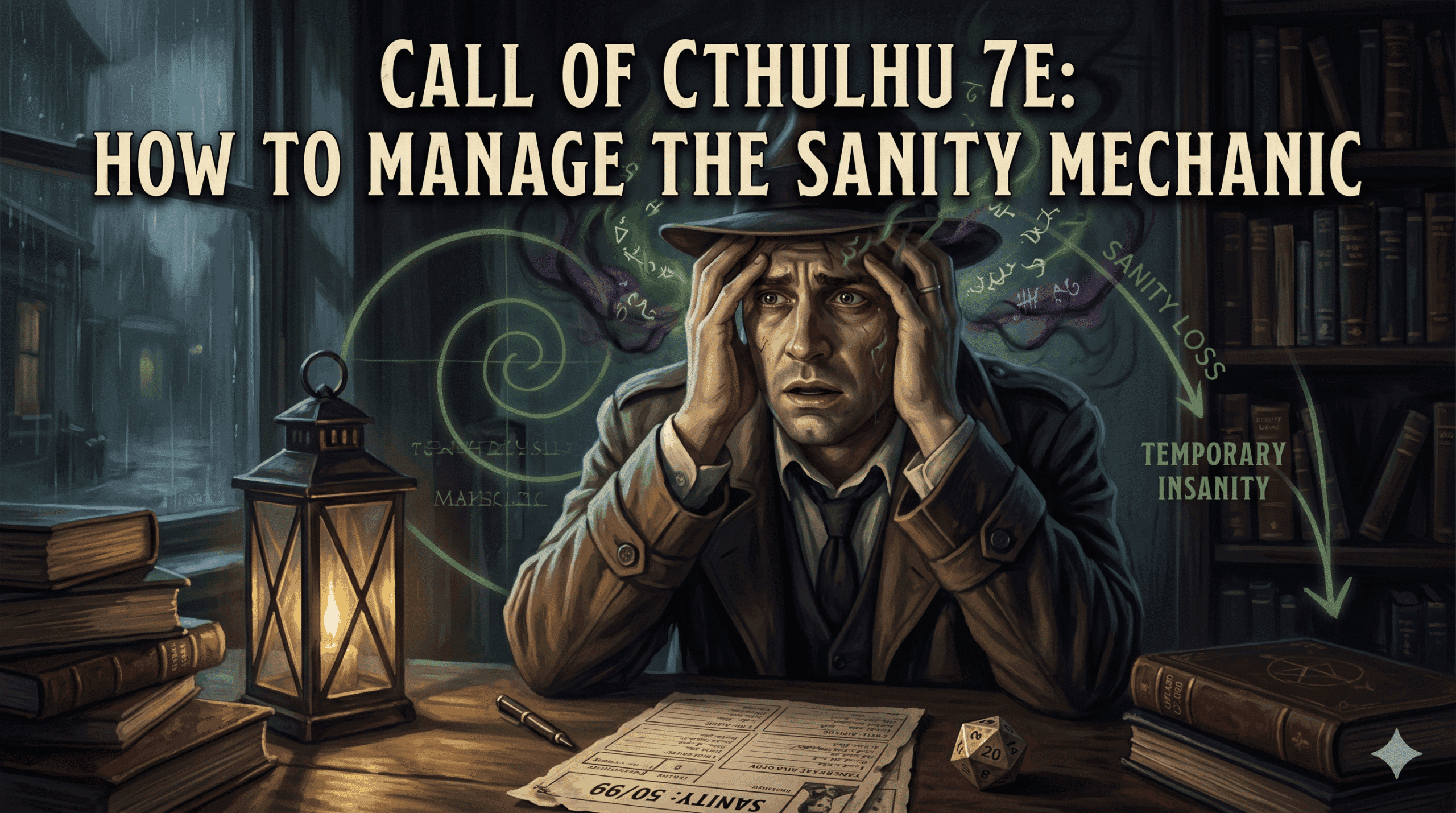
Call of Cthulhu 7e Sanity is a resource management system that tracks an investigator’s mental resilience and connection to reality. Effective management relies on the Investigative Resilience Protocol, which focuses on three pillars: using “Sanity Buffers” (backstory bonds and grounding) to mitigate attrition, implementing “Fail Forward” narrative breaks to ensure bouts of madness drive the plot, and utilizing “Slow Burn” pacing to prevent premature character retirement. By balancing these tactical elements, Keepers can maintain psychological dread without stalling the campaign’s momentum.
Table of Contents
In the high-stakes world of tactical tabletop gaming, most systems treat “health” as a resource to be protected until the final boss. But in Call of Cthulhu 7e, your most valuable resource isn’t your hit points—it’s your mind.
Over my 30 years of TTRPG playing experience, I have seen countless investigators fall not to the blade of a cultist, but to the fractured reality of the Cthulhu Mythos.
Managing the Call of Cthulhu 7e Sanity mechanic is the difference between a one-shot that ends in a premature TPK and a sweeping, multi-year campaign of psychological dread. This guide serves as a deep dive into the core mechanics of the most popular horror TTRPG, providing you with the tactical tools to master madness at your table.
1. The Anatomy of a Mental Breakdown: Mechanical Core
To truly master Call of Cthulhu 7e Sanity, we must first look at the cold, hard numbers. Unlike modern systems that favour heroic resilience, the math of Cthulhu is purposefully weighted toward attrition.
Sanity (SAN) vs. Power (POW)
Your starting Call of Cthulhu 7e Sanity is determined by your Power (POW) characteristic. This creates a fascinating tactical tension: characters with high POW are better at resisting magic and mental assault, but they often have more to lose. After three decades at the table, I’ve found that players often mistake high SAN for invulnerability. In reality, it is merely a longer fuse on an inevitable bomb.
If you start with a 70 POW, your starting SAN is 70. However, the maximum possible SAN is always 99 minus your Cthulhu Mythos skill. This means that as you become an expert in the dark arts, your ceiling for mental stability drops permanently.
The “Knowledge Curse”
One of the most brutal aspects of Call of Cthulhu 7e Sanity is this relationship with the Cthulhu Mythos skill. As your knowledge of the true nature of the universe grows, your maximum possible Sanity decreases. You cannot “un-know” the Great Old Ones. This mechanical “ceiling” is what gives the system its signature feeling of a downward spiral. In tactical games like Pathfinder 2e, gaining knowledge usually makes you stronger; in Call of Cthulhu 7e, knowledge is the very thing that erodes your capacity to function in society.
2. The Investigative Resilience Protocol (IRP)
To help Keepers and players manage this descent, I have developed the Investigative Resilience Protocol. This framework ensures that Call of Cthulhu 7e Sanity loss enhances the story rather than stalling the game.
Pillar 1: The Narrative “Fail Forward”
In many games, a failed roll means nothing happens. In this protocol, a failed Call of Cthulhu 7e Sanity check is a narrative engine. If an investigator loses their grip, they shouldn’t just sit in a corner. They should “fail forward” into a Bout of Madness that reveals a new clue or forces a desperate choice. For example, a character who suffers a bout of amnesia might “wake up” holding a bloodstained journal page—a clue they wouldn’t have found if they had remained sane.
Pillar 2: The Tactical Sanity Buffer
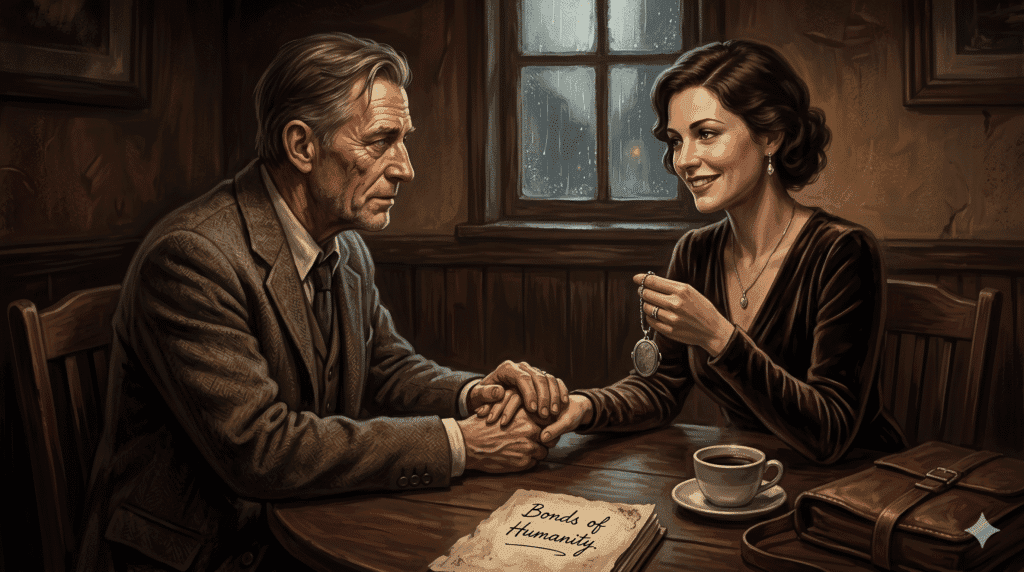
Experienced players know how to build “Sanity Buffers.” This involves utilising character Bonds and grounding techniques during “Downtime” to recover lost points. My 30 years of experience have shown that rewarding players for roleplaying these moments—visiting a loved one, indulging in a hobby, or seeking therapy—creates a much deeper emotional investment in the character’s survival. These act as mechanical “shields” for your Call of Cthulhu 7e Sanity.
Pillar 3: Keeper Pacing and “The Slow Burn”
A common mistake for new Keepers is hitting players with massive Call of Cthulhu 7e Sanity losses too early. The protocol suggests a “Slow Burn” approach:
- 1/1d3 for a grisly murder or a mutilated corpse.
- 1/1d6 for a minor supernatural event or a deep one sighting.
- 1d10/1d100 for the final cosmic revelation. By pacing the SAN loss, you maintain the tension without breaking the character before the climax.
3. Managing the Three Stages of Insanity
Understanding when and how to trigger the different levels of madness is vital for high-level table management.
- Temporary Insanity: Triggered by losing 5 or more SAN in a single roll. This represents a sudden, sharp shock to the psyche. The character suffers a “Bout of Madness” lasting 1d10 rounds (in combat) or minutes (out of combat).
- Indefinite Insanity: This occurs when a character loses 1/5th of their maximum SAN in a single “game day.” This is where the Call of Cthulhu 7e Sanity system becomes truly dangerous. The character remains “insane” until they receive successful treatment or a significant period of rest passes.
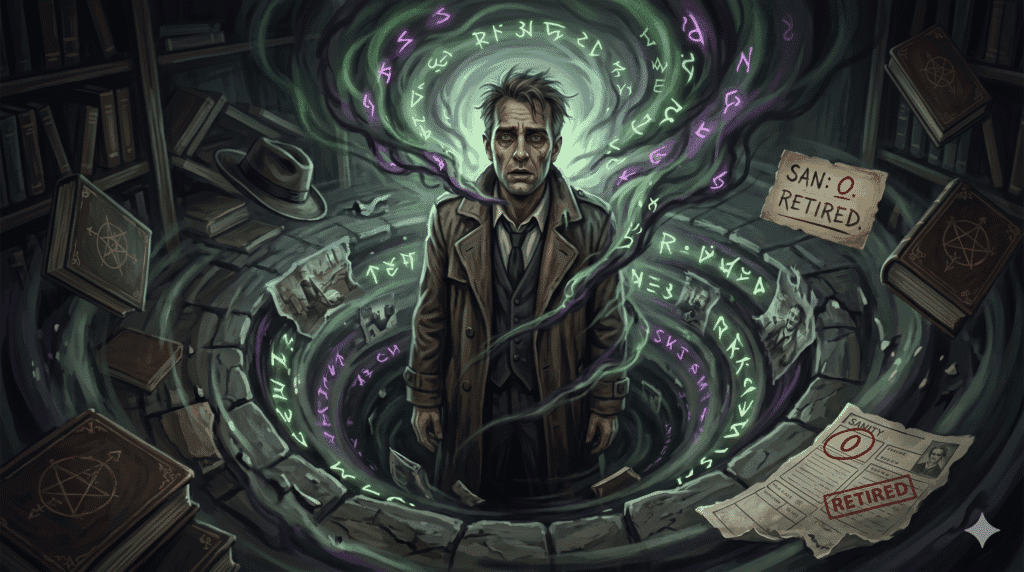
- Permanent Insanity: When SAN hits zero, the character is gone. In my three decades of gaming, these have been some of the most poignant moments. The character has seen too much; they can no longer relate to the human world and are retired as an NPC.
4. System Comparisons: Mental Stress vs. Physical Harm
To understand why Call of Cthulhu 7e Sanity is so effective, we must compare it to other popular systems. This helps transitioning players understand the “Mindset Shift” required for horror.
| System | Primary Conflict Metric | Mechanical Consequence |
| D&D 5e | Hit Points (HP) | Death / Unconsciousness |
| Pathfinder 2e | Wounds / Conditions | Tactical Debuffs / Stunned |
| Star Wars FFG | Strain Threshold | Impairment / Fatigue |
| Call of Cthulhu 7e | Sanity (SAN) | Character Retirement / Insanity |
While systems like Pathfinder 2e focus on a rigorous “Action Economy,” Call of Cthulhu 7e Sanity focuses on narrative erosion. In my experience, players coming from D&D 5e often struggle because they try to “win” a Sanity roll. In Cthulhu, you don’t win; you survive at a cost.
5. Recovery and The Road Back: Psychotherapy Rules
In a long-form campaign, managing the recovery of Call of Cthulhu 7e Sanity is just as important as managing its loss.
Private Care and Institutions
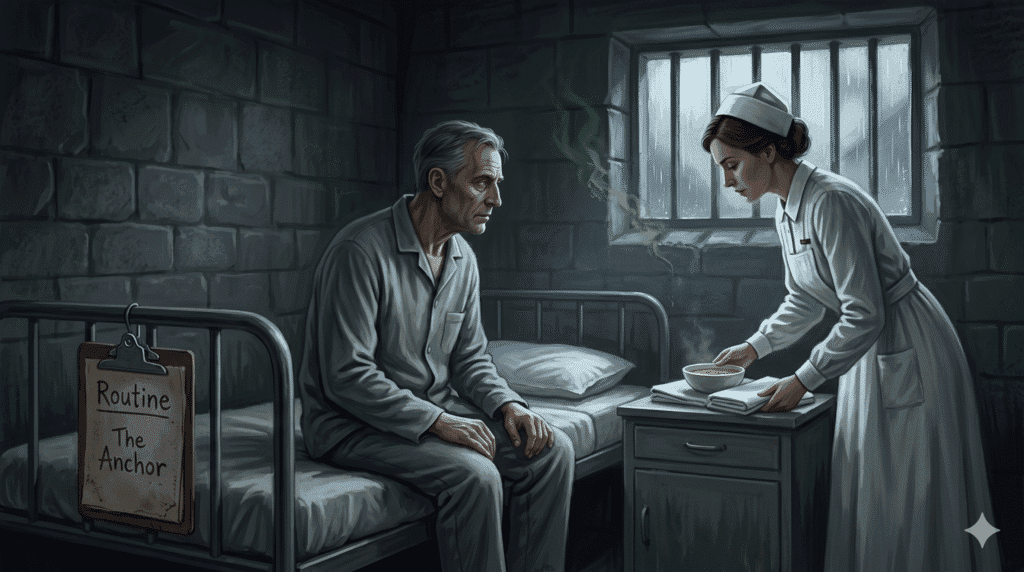
Characters can commit themselves to an asylum or seek private care. Mechanically, a successful Psychoanalysis roll can restore 1d3 Sanity points once per week. However, a failure can be catastrophic, potentially causing further loss. As a Keeper with 30 years of experience, I recommend making these scenes as interactive as the investigations themselves.
Self-Care and Meaningful Connections
One of the most underutilised rules in Call of Cthulhu 7e Sanity management is the “Self-Care” mechanic. By spending time with a “Backstory Connection”—a spouse, a mentor, or even a cherished object—an investigator can attempt to regain SAN. This reinforces the “Resilience Protocol” by giving the character something to fight for.
6. Monster Deep Dive: The Sanity Impact of the Mythos
Not all horrors are created equal. When designing encounters, you must understand the mechanical “threat level” of different creatures in terms of Call of Cthulhu 7e Sanity.
- Deep Ones (0/1d6): These are the bread and butter of horror. A 0/1d6 loss means even a success feels like a minor jolt, while a failure can trigger Temporary Insanity in an already weakened character.
- The King in Yellow (1d10/1d100): This is a campaign-ender. Encountering a Great Old One should never be a “fair” fight. The Call of Cthulhu 7e Sanity loss here is designed to break even the most hardened investigators.
- Zombies and Human Horrors (0/1d4): These serve as the “Slow Burn” components of the protocol. They drain SAN slowly, making the eventual encounter with the Mythos much more lethal.
7. Case Study: The “Haunting” of Sanity
Let’s look at how the Call of Cthulhu 7e Sanity mechanic works in a high-stakes encounter.
The investigators enter the sub-basement of the Marsh refinery. They find a Shoggoth. The SAN loss is 1d6/1d20.
The Lead Investigator, with a current SAN of 45, fails the roll and loses 15 points. This is both a shock (triggering Temporary Insanity) and represents more than 1/5th of their SAN (triggering Indefinite Insanity).
Using the Investigative Resilience Protocol, the Keeper doesn’t simply say “you are paralysed.” Instead, the investigator suffers a “Bout of Madness” where they become obsessed with the geometry of the room. They begin frantically sketching the Shoggoth’s movement patterns into the dust on the floor. While the character is “mad,” these sketches provide the rest of the team with a +10% bonus to their next Dodge roll. The horror is maintained, but the tactical momentum continues.
8. Advanced Table Management: Safety and Agency
Horror is a delicate social contract. When managing Call of Cthulhu 7e Sanity, you must ensure the players feel the fear without feeling “bullied” by the dice.
- Session Zero: Always use a “Session Zero Protocol” to establish Lines and Veils.
- The X-Card: In high-stress horror games, having a clear safety signal is vital.
- Player Agency: Even during a Bout of Madness, give the player a choice in how their character reacts. Does their “Phobia” manifest as a blind flight, or a catatonic freeze? Giving the player the choice maintains their engagement even when their character is out of control.
Call of Cthulhu 7e Sanity (FAQ)
How do you regain Sanity in Call of Cthulhu 7e?
Sanity can be regained through successful completion of scenarios (narrative rewards), successful psychotherapy (Psychoanalysis rolls), or by engaging in meaningful self-care with backstory connections during downtime.
What is the “Idea Roll” in relation to Sanity?
The Idea Roll is a unique mechanic where, after losing 5+ SAN, a character rolls to see if they “understand” what they saw. Ironically, succeeding the roll is worse, as it means the character fully grasps the horror, leading to Temporary Insanity.
What happens when my Call of Cthulhu 7e Sanity hits zero?
The character is permanently insane and becomes an NPC under the Keeper’s control. They are retired from the game as their mind can no longer function within human society.
Is it possible to “win” Call of Cthulhu 7e?
Success in Cthulhu is measured by the completion of the investigation and the survival of the character’s mind. “Winning” usually involves stopping the immediate threat while accepting that your character is forever changed.

Andragoras is a TTRPG veteran with over 30 years of experience behind the DM screen and as a player. Specialising in high-level mechanical optimisation and narrative table management, they have navigated systems from the early days of AD&D to the tactical depths of Pathfinder 2e and the narrative systems of Star Wars FFG. Their mission at RPG Player Hub is to help players and Game Masters master their craft through professional-grade guides and system-agnostic roleplay mastery.