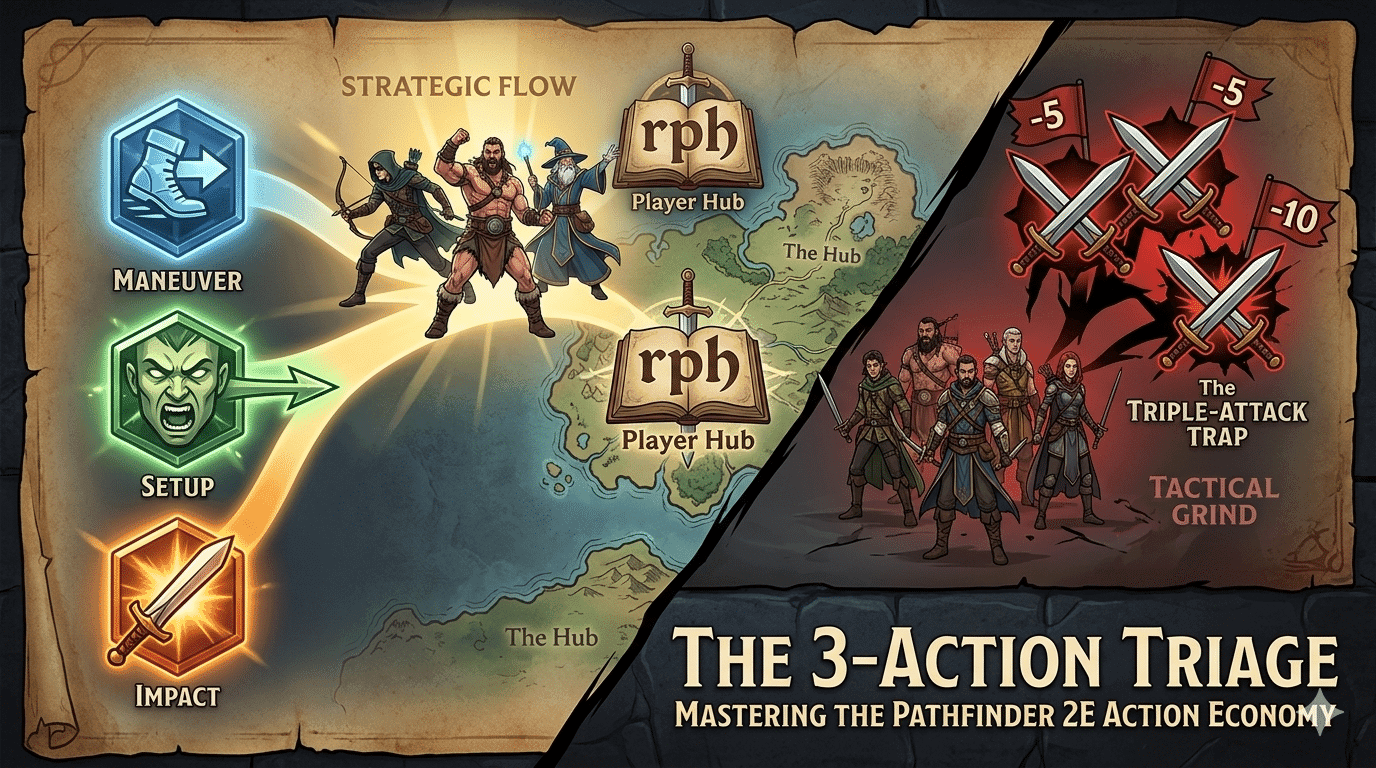
Mastering the Pathfinder 2e Action Economy requires moving beyond “Attack, Attack, Attack.” The “3-Action Triage” is a tactical framework where GMs and players prioritise (1) Position, (2) Debuff/Setup, and (3) Impact. By treating actions as a finite currency rather than a list of chores, you can reduce combat bloat by up to 30% while increasing the tactical lethality of your NPCs.
Table of Contents
What is the 3-Action Triage?
The 3-Action Triage is a tactical framework designed to maximise efficiency in Pathfinder 2e combat by categorising every turn into three distinct priorities: Positioning, Setup, and Impact. Instead of succumbing to the “Triple-Attack Trap”—where players waste actions on low-probability strikes—the Triage Protocol forces GMs and players to treat actions as a finite currency. By prioritising movement and debuffs over diminishing-return attacks, you increase tactical lethality while reducing combat “bloat” by up to 30%.
For the full strategic context, refer back to our comprehensive [Pathfinder 2e player guide].
The “Triple-Attack” Trap: Why Your Third Strike is a Waste
If you’ve struggled with the Pathfinder 2e action economy for more than a session, you’ve seen it: the fighter stands toe-to-toe with a boss and swings three times. The Pathfinder 2e action economy is a good way for a player to give themselves the freedom to act as they wish.
Statistically, that third strike is a “Hail Mary.” With a Multiple Attack Penalty (MAP) of -10 (or -8 for agile weapons), you aren’t just fishing for a natural 20; you are actively ignoring the most powerful part of the PF2e engine: Tactical Variety. In a system where a ±1 difference can determine a critical hit, throwing away an action on a -10 penalty isn’t just inefficient—it’s a missed opportunity to manipulate the battlefield.
The Triage Protocol: A Three-Step Framework
To master the 180-second “combat math” of a round, evaluate your turn through the lens of Triage.
1. The Manoeuvre (Priority: High)
In PF2e, Position is Protection. * The Logic: Forcing an enemy to waste one of their actions just to reach you is a massive net win.
- The Play: Use a Stride to flank or a Step to leave an enemy’s reach without triggering reactions. If the enemy has to Stride to hit you, you have effectively “stolen” 33% of their turn.
2. The Setup (Priority: Essential)
Before you strike, tilt the scales.
- The Logic: A +1 to your attack or a -1 to an enemy’s AC is mathematically equivalent to a 10% shift in crit probability.
- The Play: Use Demoralise (Intimidation) to Frighten, Feint (Deception) to make them Off-Guard, or Recall Knowledge to identify a weak save.
3. The Impact (Priority: Calculated)
Now, and only now, do you commit the steel.
- The Logic: One high-probability Strike is worth more than three desperate ones.
- The Play: Deliver your primary Strike or a high-impact “Press” action. If your first two actions were Triage-focused, this third action is far more likely to result in a Critical Success.
Roleplay Mastery: Cross-Pillar Perspective
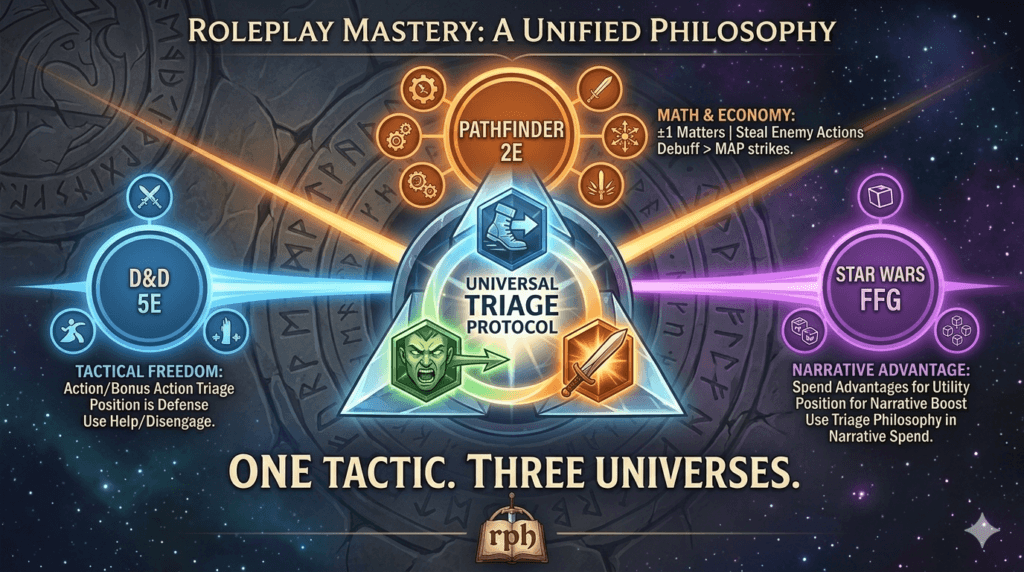
While this protocol is built for the math of Pathfinder 2e, the philosophy is universal across the Roleplay Mastery category:
- D&D 5e Perspective: In 5e, “Action Economy” is often a race to use your Bonus Action. The Triage Protocol teaches 5e players to value the Help action or Disengage to break the “static line” combat meta. [System Specific Flag]
- Star Wars FFG Perspective: In the narrative dice system, “Triage” translates to spending Advantages on environmental boosts or passing “Boost Dice” to allies rather than just dealing raw damage. [System Specific Flag]
- Universal Truth: Combat momentum is maintained by changing the state of the board, not just lowering HP totals. This works hand-in-hand with our [Combat Momentum Protocol], ensuring that tactical decisions lead to faster, more cinematic sessions.
Implementing Triage as a GM
The Pathfinder 2e action economy rewards GMs who think tactically. Don’t just teach this to your players; run your monsters this way. An Ogre that simply swings a club three times is a bag of hit points. An Ogre that Strides into a flanking position, uses Intimidate to roar at the Wizard, and then delivers one massive Strike is a terrifying predator. When the GM uses Triage, the players are forced to adapt or die.
The “Action Tax” of Healing and Items
One of the most overlooked aspects of the Pathfinder 2e action economy is the sheer cost of interacting with items and healing. In many other systems, drinking a potion or drawing a weapon is a trivial affair, often relegated to a free or bonus action. In Pathfinder 2e, it is a significant investment.
Consider the classic scenario: you are at low hit points and need to drink a healing potion. First, you must use an Interact action to draw the potion from your bandolier or backpack. Then, you must use a second Interact action to drink it. That is two of your three actions gone, leaving you with only one action to Stride away from danger or make a desperate Strike.
This “action tax” fundamentally changes how you must approach combat. It means that preventative measures—like raising a shield, taking cover, or using the Triage Protocol to debuff an enemy before they can hit you—are vastly superior to reactive healing. If you are spending your turns drinking potions, you are losing the action economy war.
The Power of the “Delay” Action
When discussing the Pathfinder 2e action economy, we must talk about the Delay action. This is not a sign of indecision; it is a tactical weapon. By choosing to lower your initiative and act later in the round, you can completely alter the flow of combat.
Imagine your Rogue is up first, but the enemy is 40 feet away. If the Rogue Strides twice to reach the enemy, they have one action left for a Strike, but they are now standing toe-to-toe with a fresh opponent who has three actions ready to unleash on their turn.
Instead, the Rogue Delays. They wait for the enemy to close the distance. The enemy spends two actions Striding to reach the Rogue, leaving them with only one action to Strike. Now, it is the Rogue’s turn. They have a full three actions to unleash on an enemy who has already spent their movement. By Delaying, the Rogue has effectively stolen two actions from the enemy and preserved their own.
Synergising with Your Party
The true mastery of the Pathfinder 2e action economy comes when you stop looking at your own three actions and start looking at the party’s collective twelve actions. Triage is not a solo endeavour; it is a team sport.
If the Fighter spends an action to Demoralise an enemy, applying the Frightened condition, they aren’t just helping their own next Strike. They are lowering the enemy’s AC and saving throws for the Wizard’s upcoming fireball, the Rogue’s sneak attack, and the Cleric’s spell attack. That single action has effectively buffed the entire party.
This is why the “Setup” phase of the Triage Protocol is so critical. When you use an action to Feint, Trip, or Grapple, you are creating a cascading effect of mathematical advantages that ripple through the entire initiative order. A party that coordinates their Setup actions will absolutely dismantle encounters that would otherwise be deadly.
Class-Specific Triage: Adapting the Protocol
The Triage Protocol is not a one-size-fits-all solution. The framework is universal, but the specific actions you choose for each phase will vary dramatically depending on your class. Understanding how your class interacts with the Pathfinder 2e action economy is the final step in mastering it.
The Fighter is the class most people think of when they imagine action economy, and for good reason. Their key advantage is the ability to use powerful two-action activities like Power Attack or Sudden Charge, which effectively compress the Triage Protocol into a single, devastating turn. A Fighter’s Triage often looks like: Demoralise (Setup), Power Attack (Impact), Raise Shield (Defence). Three actions, three distinct purposes.
The Ranger, by contrast, thrives on the Hunt Prey action. This free action (once per round) allows them to designate a target, granting a bonus to Perception and Survival checks against them. A Ranger’s Triage is therefore built around the Flurry Edge, which reduces MAP, making their third attack far more viable than it would be for any other class. For Rangers, the Triple-Attack Trap is not always a trap.
The Wizard presents the most complex Triage decisions. A Wizard’s actions are precious because they are asymmetric—a single action can cast a cantrip, two actions can cast a powerful spell, and three actions can cast a ritual. The Wizard’s Triage is therefore about spell slot conservation. Use cantrips (1 action) for Setup and positioning, and save your two-action spells for the Impact phase when the Setup has already tilted the odds in your favour.
The “Action Tax” of Movement: Why Standing Still Kills
One of the most profound shifts a player must make when transitioning from D&D 5e to Pathfinder 2e is understanding the true cost of movement. In 5e, movement is a separate resource pool; you can break it up, move before and after an attack, and it costs you nothing in terms of your offensive output. In the Pathfinder 2e action economy, movement is an action. Every time you Stride, you are spending 33% of your turn. This creates a dynamic that I call the “Action Tax” of movement. If a melee character has to spend two actions just to reach their target, their turn is effectively over before it begins. They have one action left for a single Strike, leaving them standing adjacent to a fresh enemy who now has three actions to unleash upon them. This is a mathematically disastrous trade.
To master the Pathfinder 2e action economy, you must learn to make the enemy pay the Action Tax instead of paying it yourself. This involves using the environment, reach weapons, and readied actions to force the enemy to come to you. Consider a Fighter armed with a halberd — a reach weapon. Instead of Striding up to an Orc, the Fighter Strides to a point exactly 10 feet away and uses their remaining two actions to Ready a Strike with the trigger: “When the Orc moves within my reach.” The Orc, armed with a standard greataxe, must now spend an action to Stride. As soon as they enter the 10-foot radius, the Fighter’s Readied Strike triggers. The Orc takes damage before they even get to swing. Furthermore, the Orc must spend a second action to Step adjacent to the Fighter if they want to attack, leaving them with only one action for a single Strike. The Fighter has successfully forced the Orc to pay a two-action tax just to engage.
The “Third Action” Dilemma: Beyond the Strike
We have established that the “Triple-Attack Trap” is a mathematical dead end due to the Multiple Attack Penalty. But this leaves many players staring at their character sheets, wondering what to do with that final action. If you are not swinging your sword, what are you doing? The answer lies in understanding that the Pathfinder 2e action economy is designed to reward lateral thinking. Your third action should almost never be an attack; it should be a utility move that either protects you or sets up an ally.
If you are wielding a shield, the Raise a Shield action is the gold standard for a third action. It grants a +2 circumstance bonus to AC, which in PF2e math means you are 10% less likely to be hit and 10% less likely to be critically hit. Alternatively, the Step action allows you to move 5 feet without triggering reactions. If you have delivered your primary strikes, use your third action to Step away from the enemy — this forces them to spend an action to re-engage you on their turn, trading your lowest-value action (a -10 MAP attack) for their highest-value action (their first action of the turn). For characters with high Intelligence or Wisdom, Recall Knowledge is an invaluable third action: identifying an enemy’s lowest saving throw allows your spellcasters to target that specific vulnerability, drastically increasing the party’s overall damage output. And if you are adjacent to an enemy and have an ally about to attack, the Aid action lets you use your reaction to grant them a circumstance bonus — the essence of party synergy.
Spellcasters and the Action Economy: The Two-Action Anchor
While martial characters often struggle with what to do with their third action, spellcasters face the opposite problem: they rarely have enough actions to do what they want. The vast majority of spells in Pathfinder 2e require two actions to cast. This creates a “Two-Action Anchor” that heavily restricts a spellcaster’s mobility and utility. If a Wizard wants to cast Fireball, they must spend two actions. This leaves them with exactly one action to either Stride into position, Stride away from danger, or use a single-action utility like Recall Knowledge or Demoralise. They cannot do both. To master the Pathfinder 2e action economy as a spellcaster, you must build your character and your spell list with this limitation in mind, actively seeking out single-action spells and abilities to fill the gaps in your turns.
Spells like Shield (the cantrip), Sure Strike (from the remaster), and Jump are critical tools for a spellcaster. They allow you to maximise your turn when you are forced to move. If you must spend an action to Stride out of melee range, you can follow it up with a single-action Sure Strike to set up a devastating spell attack on your next turn, or cast the Shield cantrip to protect yourself. Many powerful control spells — like Flaming Sphere or Hideous Laughter — also require only one action to Sustain on subsequent turns. This is a massive advantage: a Druid who casts Flaming Sphere on turn one can, on turn two, Sustain the sphere (1 action) and cast Electric Arc (2 actions), effectively dealing the damage of two spells in a single round. Metamagic feats like Reach Spell or Widen Spell add further flexibility, allowing you to modify your spells to overcome range or area limitations without sacrificing your movement. By understanding the Two-Action Anchor and preparing single-action solutions, spellcasters can transform from static artillery pieces into dynamic, highly mobile battlefield controllers.
(FAQ) Pathfinder 2e Action Economy
Does using 3-Action Triage slow down the game?
Actually, it speeds it up. When players stop agonising over “should I swing a third time?”, and instead follow a Triage flow (Move, Debuff, Hit), turns become more decisive and cinematic.
Is it ever okay to swing three times?
Rarely. Only if an enemy is effectively at 1 HP or if you have specific “Flurry” abilities that mitigate MAP. Otherwise, the math almost always favours a Manoeuvre or a Setup.
What is the best “Setup” action for a non-caster?
Demoralise and Trip are king. Frightened 1 and Off-Guard are the two easiest ways to ensure your party’s heavy hitters land their crits.

Andragoras is a TTRPG veteran with over 30 years of experience behind the DM screen and as a player. Specialising in high-level mechanical optimisation and narrative table management, they have navigated systems from the early days of AD&D to the tactical depths of Pathfinder 2e and the narrative systems of Star Wars FFG. Their mission at RPG Player Hub is to help players and Game Masters master their craft through professional-grade guides and system-agnostic roleplay mastery.
4 responses