
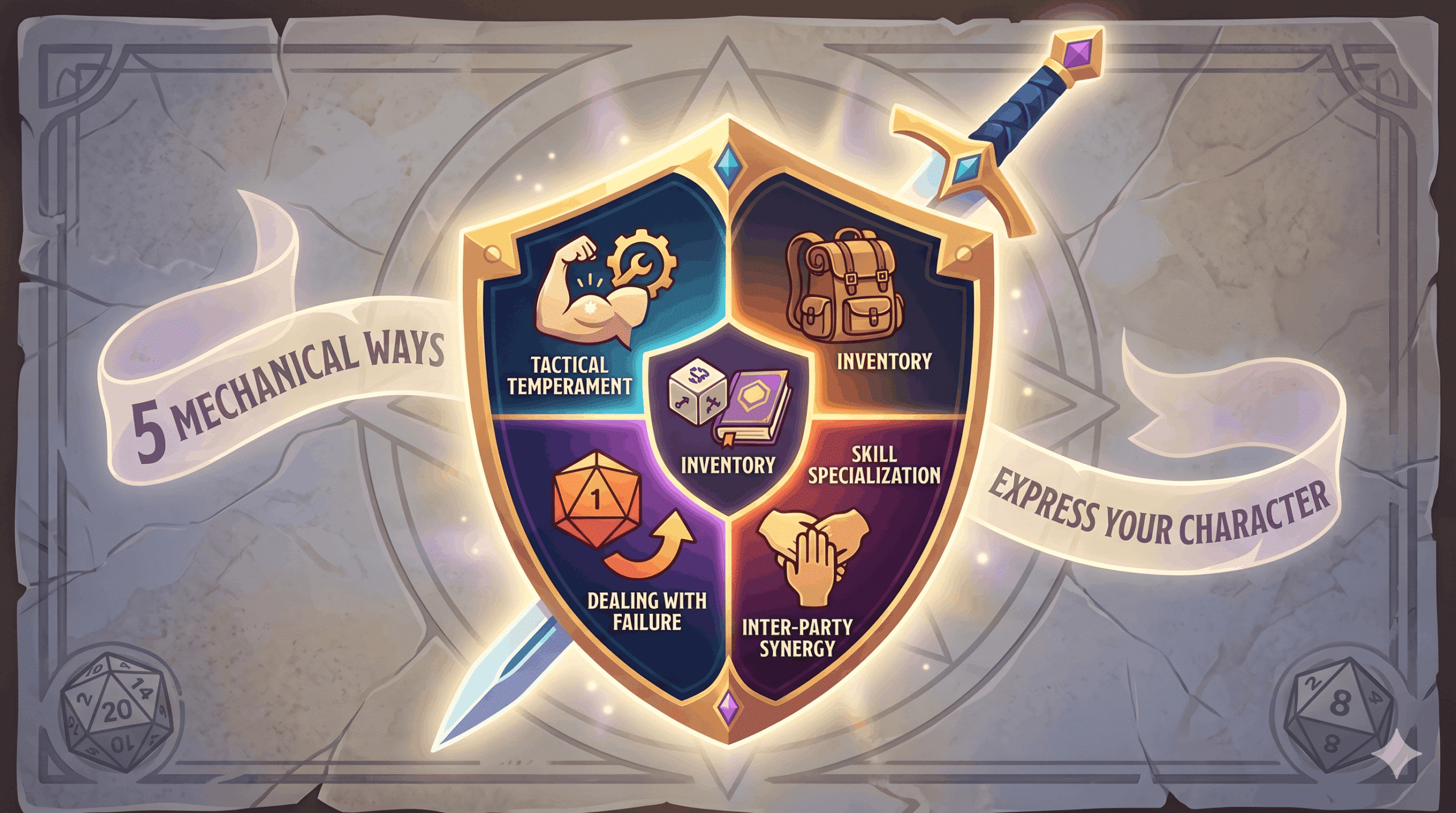
Table of Contents
Section 1: Introduction – The Myth of the “Funny Voice”
In the modern era of actual-play streams and high-production podcasts, a common misconception has taken root in the tabletop community: that “good roleplaying” is synonymous with being a trained voice actor. Many players sit down at the table feeling immense pressure to deliver a flawless accent or a dramatic monologue, believing that if they aren’t “in character” vocally, they aren’t truly roleplaying.
However, having spent over 30 years of TTRPG playing experience at the table—navigating through the transition from the “crunch” of 2nd Edition AD&D to the narrative-heavy systems of today—I can tell you that the most profound storytelling doesn’t happen in your throat; it happens on your character sheet. This is the art of expressing character personality in TTRPGs through mechanics.
The Disconnect Between Sheet and Story
Too often, there is a “wall” between the numbers and the narrative. A player might describe their warrior as a cautious, protective mentor, but on the battlefield, they play like a reckless berserker because “that’s what the math says to do.” This creates a narrative dissonance that pulls everyone out of the immersion. True mastery of the hobby comes when you learn to express character personality in TTRPGs by making mechanical choices that reflect who your character is at their core.
Why Mechanics Matter for Roleplay
Your character’s stats, feats, and equipment aren’t just tools for winning; they are the script for your character’s behaviour. When you choose a specific manoeuvre or decide how to spend your precious actions, you are making a narrative statement. Whether you are playing a high-fantasy hero or a survivor in a horror setting, learning to express character personality in TTRPGs mechanically ensures that your character feels consistent, three-dimensional, and integrated into the world.
To see how this level of mechanical intent looks in practice, you can refer to my Combat Momentum Protocol, which explores how keeping the tactical flow moving actually enhances the narrative tension of the story.
Section 2: Method 1 – Tactical Temperament (How You Fight)
The most immediate way to express character personality in TTRPGs is through your “Tactical Temperament.” In almost every system, combat is where the most mechanical decisions are made in the shortest amount of time. Every choice—where you stand, who you target, and when you retreat—is a window into your character’s soul.
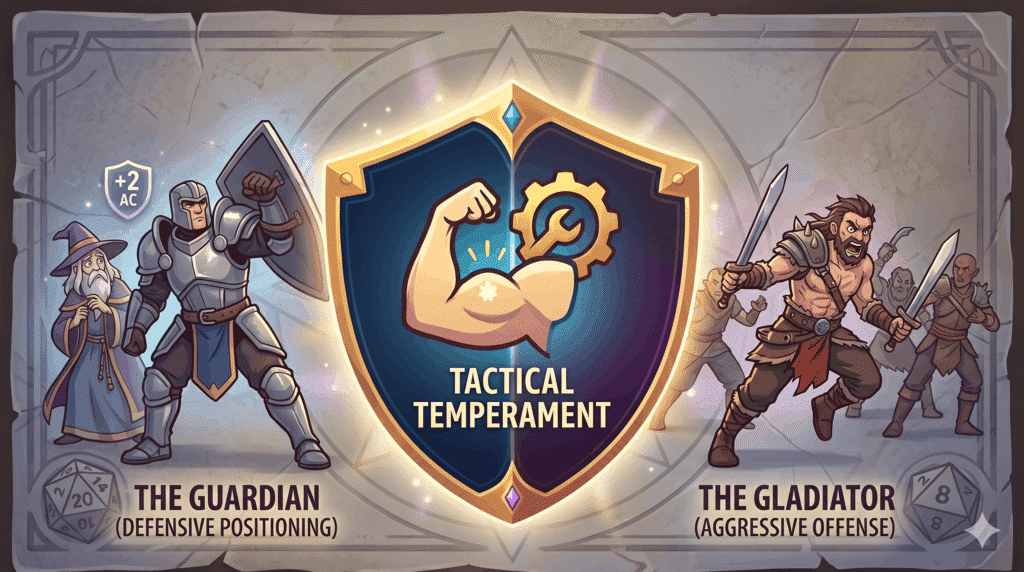
The “Guardian” vs. The “Gladiator”
Consider two different Fighters with identical stats. One always uses their actions to “Raise a Shield” and stands adjacent to the party’s wizard. This is a Guardian temperament. The math (a higher AC and the ability to Shield Block) tells a story of self-sacrifice and paternal protection.
In contrast, the Gladiator temperament might ignore their shield entirely, focusing on dual-wielding or heavy-hitting manoeuvres, constantly seeking the centre of the fray. They are expressing character personality in TTRPGs through aggression and a need for glory. Even if both characters are “optimised,” their mechanical behaviour creates two entirely different people.
Math as a Narrative Tool
In complex systems like Pathfinder 2e, the three-action economy is a playground for personality. A character who spends their third action to “Recall Knowledge” shows a studious, analytical mind—a character who uses it to “Intimidate” projects a bullying or terrifying presence. When you express character personality in TTRPGs this way, the other players don’t need a funny voice to know who your character is; they see it in how you interact with the grid.
A perfect example of this is found in my guide to Surviving the Frontline: The Complete PF2e Champion Build. The Champion is the ultimate class for expressing character personality in TTRPGs because their very reactions (The Redeemer vs. The Paladin) force the player to make a moral and tactical choice simultaneously.
For further reading on how personality psychology can influence your tactical choices, the 16 Personalities in Fiction guide offers great insights into how different mindsets approach conflict and problem-solving.
Section 3: Method 2 – Inventory as Identity (What You Carry)
The items listed on your character sheet are more than just a list of bonuses and survival tools; they are a window into your character’s history, anxieties, and preparedness. Learning to express character personality in TTRPGs through inventory management is a subtle but powerful way to show, rather than tell, who your character is. After 30+ years of TTRPG playing experience, I’ve noticed that players often forget that the “stuff” they carry is a narrative weight that defines their persona.
The “Kit” Personality: Preparedness vs. Minimalism
Think about the difference between two characters entering a dungeon. The first has a specialised tool for every occasion—three different types of rope, a collapsible ten-foot pole, various vials of acid, and a magnifying glass. This character is expressing character personality in TTRPGs as a meticulous “Problem Solver” or perhaps an anxious survivor who refuses to be caught off guard.
The second character carries only a rusted blade, a single torch, and a half-empty flask. This minimalism tells a story of desperation, supreme confidence, or perhaps a nihilistic streak. By carefully curating your inventory, you are using the game’s weight and slot mechanics to build a tangible history for your hero.
The “Sentimental Item” Appendix: Narrative Weight in Active Slots
One of the most effective ways to express character personality in TTRPGs is by carrying items that have zero mechanical combat value. In systems with limited inventory slots or encumbrance rules, choosing to carry a “useless” item is a significant mechanical sacrifice that highlights a character’s priorities.
To help you implement this, I have curated a list of sentimental items that can define a character’s persona through the sheer act of keeping them on the sheet:
| The Sentimental Item | Associated Personality Trait | The Narrative Expression |
| A Rusted, Blunt Locket | Grief or Lost Love | The character refuses to let go of a past they cannot change, perhaps impacting their willingness to trust new allies. |
| A Set of Weighted Dice | Dishonesty or Survivalism | Even if never used, their presence suggests a character who always has a “Plan B” that involves cheating the system. |
| A Bundle of Dried Lavender | Homesickness or Peacefulness | Used as a sensory anchor, this indicates a character who is poorly adjusted to the violence of adventuring. |
| A Blood-Stained Enemy Banner | Vengeance or Trauma | Carrying a trophy from a fallen foe shows a character defined by a specific conflict or an inability to move past a war. |
| An Unfinished, Crumpled Letter | Regret or Unresolved Business | A character who is constantly “about to” settle a debt or apologise, but lacks the courage to send the message. |
Consumables as Narrative Flaws
How your character handles limited resources is a prime opportunity to express character personality in TTRPGs.
- The Hoarder: Does your character refuse to drink a healing potion even when at 5 HP because they are “saving it for a real emergency”? This mechanical stubbornness suggests a character who has experienced scarcity or loss.
- The Altruist: Do they immediately use their only “Remove Curse” scroll on an NPC rather than saving it for the party? That mechanical choice is a definitive role-playing moment.
This concept ties directly into the “Triage Protocol” I discuss in Mastering the Pathfinder 2e Action Economy. Deciding whether to spend an action to retrieve an item or use a consumable is the ultimate test of a character’s priorities under pressure. For a deeper look at how a character’s “loadout” influences their story, check out The Loadout in TTRPG Design over at Dicebreaker.
Section 4: Method 3 – The “Signature Move” (SkillSpecialisation)
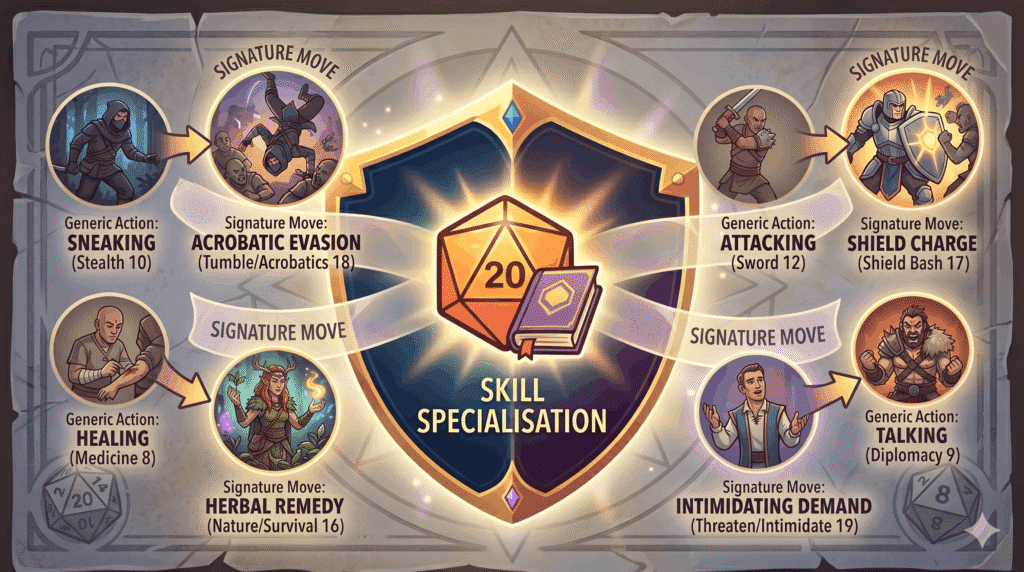
In every RPG system, from 5e to Call of Cthulhu, you are forced to choose what you are good at and, by extension, what you are bad at. Specialisation is one of the most effective ways to express character personality in TTRPGs because it defines your character’s “Signature Move”—the action they take when the chips are down.
Specialisation as a Script
Why did your Rogue choose Expertise in Athletics instead of Stealth? Perhaps they aren’t a sneaky thief, but a “Strongman” who prefers to break doors down and grapple enemies. By picking specific skills and feats, you are expressing your character’s personality in TTRPGs by narrowing the scope of how your character interacts with the world. You are telling the GM: “This is how my character solves problems.”
Mechanical Flavour in Spellcasting
For magic users, your spell list is your personality. A Warlock who only takes spells that manipulate the mind is vastly different from one who only takes spells that conjure fire. When you express character personality in TTRPGs through spell selection, you are defining the nature of your character’s power.
In my guide to The Ultimate Hexblade Warlock Build 5e, I break down how choosing melee-centric spells over traditional ranged options transforms the Hexblade from a “caster who hits things” into a “supernatural duelist” with a very specific, aggressive persona.
Section 5: Method 4 – Dealing with Failure (The Math of the Miss)
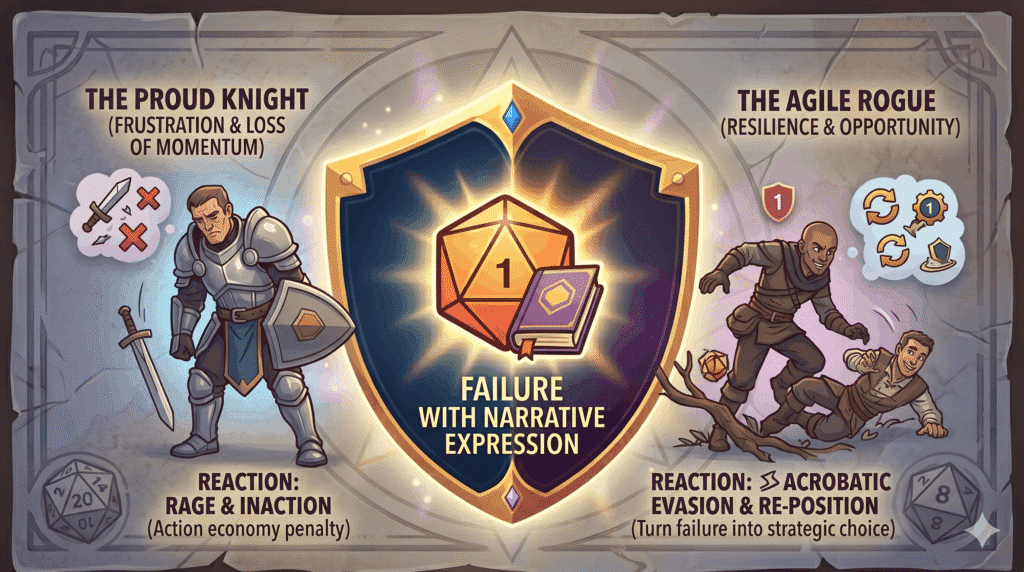
One of the hardest lessons for players to learn is that failure is a gift for storytelling. In my 30+ years of TTRPG playing experience, some of the best character moments I’ve ever witnessed came from a natural 1. To truly express character personality in TTRPGs, you must learn to roleplay the math of the miss.
Roleplaying the Dice
When you miss an attack or fail a save, don’t just sigh and wait for your next turn. Use the mechanics of that failure to express character personality in TTRPGs.
- Does your proud Paladin get flustered and angry after a miss, making their next attack even more reckless?
- Does your analytical Wizard mutter a correction to their verbal components?
Narrative Failure Systems
Some modern systems have built-in mechanics to help you express character personality in TTRPGs through failure. In systems like Star Wars FFG, you can fail a check but still spend “Advantage” to help an ally. This allows you to play a “Bumbling Hero” who succeeds through sheer luck or a “Martyr” who fails their own task but sets the team up for victory.
I explore this in depth in Mastering Star Wars FFG Narrative Dice: The Advantage Protocol, showing how the dice themselves can lead the roleplay if you let the mechanics guide your character’s reactions.
Section 6: Method 5 – Building for Conflict (Inter-Party Synergy)
Roleplaying is rarely a solo act. To truly express character personality in TTRPGs, you must look at how your character’s mechanical footprint affects the rest of the party. After 30+ years of TTRPG playing experience, I’ve found that the most memorable characters aren’t just powerful individuals; they are those whose very presence on the battlefield reinforces their relationships with their companions.
Collaborative Mechanics as Character Growth
Does your character spend their actions to “Aid” or “Buff” others, or do they hoard their resources for their own “big moments”? A character who spends their turn granting an ally an extra attack or a bonus to hit is expressing character personality in TTRPGs as a supportive leader or a loyal friend.
Conversely, a character who refuses to engage in teamwork mechanics—perhaps a “loner” Rogue or a “power-hungry” Mage—is using the rules to highlight their personal flaws. Over time, as that character begins to use more cooperative actions, you aren’t just playing the game more effectively; you are showing mechanical character growth.
The “GM-Player Contract”: Communicating Sub-Optimal Choices
One of the most advanced ways to express character personality in TTRPGs is by intentionally making “sub-optimal” mechanical choices to reflect a character flaw. However, this requires a “Contract” with your Game Master to ensure they understand your intent.
If you decide your character is “Terrified of Fire” and refuse to move within 10 feet of a campfire or a fire giant, a GM who doesn’t know your intent might think you’re simply being difficult or don’t understand the rules. By establishing a contract, you turn a mechanical hindrance into a narrative hook.
- The Intent Statement: Tell your GM, “I am building my character with a low Will save against fear effects to highlight their cowardice.”
- The Reward Cycle: Many systems, like D&D 5e, allow GMs to award Inspiration when you play to your flaws. By expressing character personality in TTRPGs through these weaknesses, you provide the GM with “leverage” to make the story more interesting.
- Safety Net: This communication ensures that when you choose a narrative action over a “correct” tactical move, the table sees it as a brilliant roleplay moment rather than a tactical blunder.
Proving Heroism Through Teamwork
Mechanical “Heroism” is proven when you take a penalty to yourself to save someone else. Whether it’s using a reaction to intercept an attack or spending a rare consumable to cure an ally’s condition, you are expressing character personality in TTRPGs through self-sacrifice.
I discuss this extensively in The Synergy Protocol: Mastering Pathfinder 2e Teamwork. In that guide, we explore how a character’s narrative “bravery” is worthless if it isn’t backed up by the mechanical willingness to support the team under fire. Proving your character’s loyalty through a +1 bonus or a life-saving “Lay on Hands” is often more impactful than any speech you could give.
For an even deeper look into how these group dynamics can be built into the very foundation of your game, I recommend checking out the TTRPG Teamwork Guide by Flutes Loot, which breaks down how cooperative play transforms the gaming experience.
Section 7: System-Specific Implementation: Expressing Character Personality in Popular TTRPGs
If there is one thing that 30+ years of TTRPG playing experience has taught me, it’s that the character sheet is not a cage—it is a script. You don’t need to be a professional actor to bring a character to life. By focusing on tactical temperament, inventory management, skills specialisation, the math of failure, and party synergy, you can express character personality in TTRPGs in a way that is consistent, engaging, and deeply integrated into the game’s world.
The Evolution of the Table
The hobby has come a long way since the days of simple dungeon crawls, but the core truth remains: the best stories happen when the players’ choices matter. When you learn to express character personality in TTRPGs through the mechanics of the game, every level-up becomes a narrative milestone, and every combat encounter becomes a scene in an epic story.
Final Thoughts
Next time you sit down to play, look at your character sheet not as a collection of numbers to be maximised, but as a personality waiting to be revealed. Ask yourself how each feat and spell choice helps you express character personality in TTRPGs to your friends at the table. For those ready to take their mechanical mastery to the next level, I highly recommend starting with my Pathfinder 2e Player Guide: The Path to Mastery. It’s designed to help you navigate the complex math of the game while never losing sight of the hero—and the personality—behind the numbers.
By following these five methods, you’ll find it’s easier than ever to express character personality in TTRPGs every time you roll the dice.
FAQ
Do I need to be an expert in the rules to roleplay mechanically?
Not at all. Even simple choices, like deciding to carry a specific sentimental item in your inventory, are a way to express character personality in TTRPGs. As you learn more rules, you just gain more “tools” for your storytelling.
Can mechanical roleplaying replace acting?
They work best together! You can still use a funny voice or a dramatic monologue, but having those actions backed up by your mechanical choices makes the role-playing feel “earned” and authentic.
Does this work in “rules-light” systems?
Yes! Even in systems with very few rules, how you spend your limited resources or which broad skills you choose is the primary way you express character personality in TTRPGs.
What if the “optimal” move contradicts my character’s personality?
This is the ultimate role-playing test. Sometimes, making the “sub-optimal” choice for the sake of the story is the most powerful way to express a character’s personality in TTRPGs. Just ensure your party is okay with it first!

Andragoras is a TTRPG veteran with over 30 years of experience behind the DM screen and as a player. Specialising in high-level mechanical optimisation and narrative table management, they have navigated systems from the early days of AD&D to the tactical depths of Pathfinder 2e and the narrative systems of Star Wars FFG. Their mission at RPG Player Hub is to help players and Game Masters master their craft through professional-grade guides and system-agnostic roleplay mastery.