
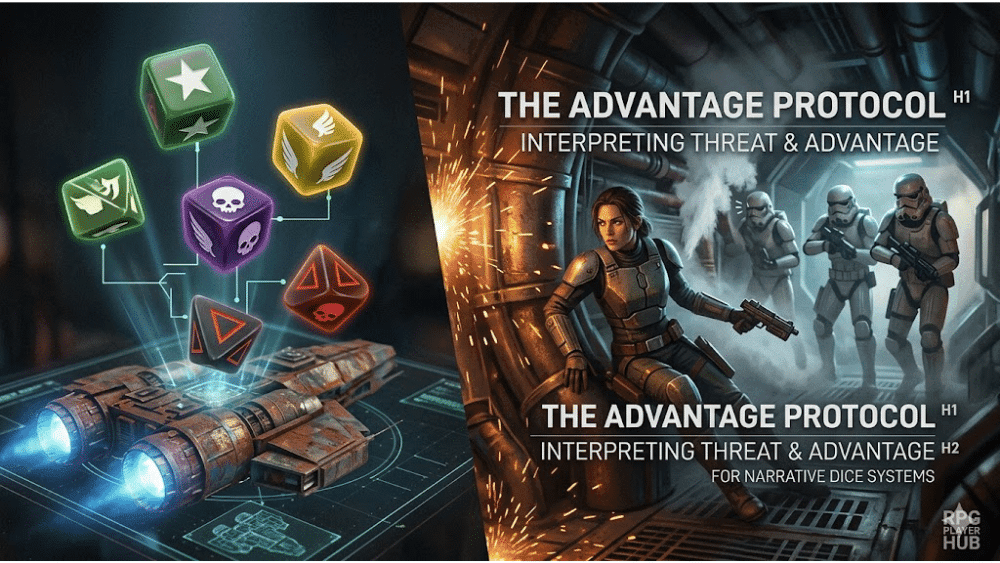
Mastering the Star Wars FFG Narrative Dice system requires moving beyond mechanical bookkeeping and into “Narrative Bridging.” Instead of treating Advantage and Threat as simple math (like +1 Boost or -1 Strain), veteran GMs use the Advantage Protocol: a framework that categorizes results into Environmental Shifts, Tactical Openings, or Narrative Complications. This ensures the story evolves with every roll, maintaining cinematic momentum even on a failed check. By prioritizing narrative consequence over numerical increments, you transform a math-heavy session into a high-stakes cinematic experience.
Table of Contents
The Narrative Pause: Why GMs Struggle with FFG Dice
The biggest speed-killer in Star Wars FFG Narrative Dice (Edge of the Empire, Age of Rebellion, Force and Destiny) is the “narrative pause.” We’ve all seen it: a player rolls a complex pool, cancels out the symbols, and ends up with a “Success with 3 Threat.” The table goes silent for 10 seconds while the GM tries to think of something more interesting than “you take 3 strain.”
After 30 years at the table, I’ve realised that players don’t remember the strain they took; they remember the steam pipe that burst and blinded the stormtroopers. To eliminate the pause, you need a mental shortcut.
The Advantage Protocol: Interpret Results in Seconds
To maintain cinematic momentum, you must categorise your interpretations into three distinct pillars. When the dice hit the table, don’t look at the symbols as numbers—look at them as one of these three outcomes:
1. Environmental Shifts (The Board)
Instead of affecting the character’s “stats,” affect the room they are standing in. This is the most “Star Wars” way to handle dice.
Advantage: A blast door slides shut, providing unexpected cover; a terminal sparks, creating a distraction; or a cargo crane swings into the path of an oncoming speeder.
Threat: The lights flicker out in the hangar; the floor becomes slick with coolant, creating difficult terrain; or an automated fire suppression system fills the room with thick, obscuring gas.
2. Tactical Openings (The Action)
Focus on the “Next Turn” economy. This is for the players who enjoy the mechanical depth found in systems like Pathfinder 2e.
Threat: Your blaster’s power cell flickers (adding a Setback die to the next shot); or you lose your footing and fall prone while trying to dodge.
Advantage: You notice a gap in the Dark Trooper’s plating (granting +1 Pierce on the next hit); or you force the enemy to retreat into a vulnerable corner.
3. Narrative Complications (The Story)
This is the domain of Triumphs and Despair. These shouldn’t just be “more damage” or “more failure.” They should change the goal of the scene.
- Triumph: You didn’t just hack the terminal; you found an encrypted file about the villain’s true motive that changes your mission entirely.
- Despair: You hit the stormtrooper, but your stray bolt hit the alarm panel behind him, alerting the entire block to your presence.
The GM’s Fine-Tuning: Setbacks vs. Difficulty
A common mistake among intermediate GMs is overusing Difficulty (Purple) dice when they should be using Setback (Black) dice.
Difficulty represents how inherently hard a task is (e.g., shooting a target at long range). Setbacks represent external, temporary factors (e.g., shooting while it’s raining).
As a veteran GM, you should lean into Setbacks. Why? Because many player talents in the Fantasy Flight Games system are specifically designed to “Remove 2 Setback dice.” If you only increase the difficulty, those player talents become useless. By adding Setbacks for smoke, noise, or stress, you are giving your players the chance to feel like heroes when their training allows them to ignore those penalties.
The Destiny Point Pivot: Upping the Stakes
The Destiny Pool is the heartbeat of the Star Wars FFG Narrative Dice system. Never flip a Dark Side point just to “make it harder.” Instead, use the flip to narratively justify a Red Challenge die.
If you flip a point to upgrade a Purple die to a Red one, describe the sudden shift in the scene. Maybe the villain isn’t just a good shot—maybe they have just noticed the player’s old injury, or the terrain has suddenly become lethal. This turns a mechanical “upgrade” into a narrative “escalation.”
Triumph vs. Success: A Golden Rule
One of the most profound “aha!” moments for a GM is realising that a Triumph is not a “Critical Success.” It is a separate event.
The Protocol: A Triumph should change the environment or the stakes even if the action itself fails.
Example: A player tries to jump across a chasm and fails, but rolls a Triumph.
- The Result: They fall into the chasm (The Failure), but they happen to land on a garbage chute or catch a protruding ledge that leads to a secret rebel cache (The Triumph).
This is the “Indiana Jones” style of storytelling that makes the Star Wars FFG Narrative Dice system the gold standard for cinematic gaming.
Universal Truth: Success is Secondary to Momentum
Whether you are playing D&D 5e, Pathfinder 2e, or Star Wars FFG, the “fail state” should never be “nothing happens.”
The FFG dice explicitly allow for “Failure with Advantage.” This is a gift to the GM. It allows the story to move forward even when the players are rolling poorly. In the Roleplay Mastery category, we call this “Failing Forward.” The Star Wars FFG Narrative Dice system rewards GMs who embrace this philosophy. Never let a roll end the scene. If the door doesn’t open, the Advantage should reveal a ventilation shaft. If the social check fails, the Threat might mean they believe you, but they now expect a massive bribe.
The “Yes, And” Philosophy of the Dice
One of the most powerful ways to use the Star Wars FFG Narrative Dice system is to embrace the improvisational comedy rule of “Yes, And.” When a player rolls a pool with a mix of Successes and Threats, or Failures and Advantages, they are essentially handing you a prompt. Your job as the GM is not to shut them down, but to build on what the dice have given you.
If a player rolls a Failure with 3 Advantage while trying to slice a security door, the “No” approach is simply saying, “The door doesn’t open, but you find a credit chip on the floor.” That’s boring. The “Yes, And” approach is saying, “The door doesn’t open, and you realise it’s because the power to this entire sector has been rerouted to the detention block. However, your slice attempt did manage to download the guard patrol schedule to your datapad.”
You have honoured the Failure (the door is still locked), but you have used the Advantage to give them a new piece of the puzzle. This keeps the players engaged and the story moving, even when the mechanical outcome is negative.
Managing the “Advantage Economy”
A common pitfall for new GMs is letting players hoard their Advantage or use it exclusively for mechanical benefits, like recovering Strain or passing a Boost die to the next player. While these are valid uses, they don’t contribute to the cinematic feel of the game.
To combat this, you need to actively manage the “Advantage Economy.” When a player rolls a significant amount of Advantage, don’t just ask, “What do you want to do with that?” Instead, offer them a choice between a mechanical benefit and a narrative one.
“You rolled 4 Advantage. You can either recover 4 Strain, or you can use that Advantage to notice that the bounty hunter’s jetpack is leaking fuel, giving you a clear target for your next shot.”
Nine times out of ten, players will choose the narrative option because it’s more exciting. By presenting the choice, you are training them to think beyond the numbers on their character sheet and engage with the fiction of the scene.
The Danger of “Nothing Happens”
I cannot stress this enough: in the Star Wars FFG Narrative Dice system, “nothing happens” is the worst possible outcome of a roll. If a player rolls a complete wash—zero Successes, zero Failures, zero Advantage, zero Threat—you have a problem. The story has stalled.
When this happens, it’s usually a sign that the stakes weren’t high enough to warrant a roll in the first place. If there’s no consequence for failure, don’t make them roll. Just let them succeed and move on.
However, if you do end up with a wash on a critical roll, use it as an opportunity to introduce a new element to the scene. “You spend several tense minutes trying to bypass the security lock, making no progress. Suddenly, your comlink crackles to life. It’s the Imperial patrol, and they’re requesting a status update from the guard you just knocked out.”
The roll didn’t change the state of the lock, but it did change the state of the scene. The pressure is now on, and the players have to react to a new threat. This keeps the momentum going and ensures that every roll, even a wash, has a meaningful impact on the story.
The “Three-Act” Combat Structure: Pacing with Dice
One of the most common mistakes I see new GMs make when running the Star Wars FFG Narrative Dice system is treating combat like a static slugfest. In D&D 5e, it is perfectly acceptable for a Fighter to stand in one square and swing their sword for five consecutive rounds until the goblin’s hit points reach zero. In the FFG system, if your players are standing still and just rolling to hit, you are failing the system. To truly master the FFG dice, you must structure your encounters using a “Three-Act” pacing model, driven entirely by the accumulation of Threat and Advantage.
In the opening rounds — Act I — the difficulty should be relatively standard. Players are rolling their base pools, trying to establish a foothold. During this phase, your job as the GM is to aggressively spend Threat to alter the battlefield. Do not just inflict Strain. If a player rolls a Failure with Threat, use that Threat to have the enemy take cover, call for reinforcements, or activate a hazard. You are using the dice to build the tension. By round three — Act II — the board should look completely different than it did in round one. The blast doors are closing, the room is filling with smoke (adding Setback dice to everyone), and the Destiny Pool has likely flipped back and forth a few times. This is when you start upgrading Difficulty dice to Challenge dice. The players should feel the pressure mounting.
If combat lasts into Act III — round five and beyond — it is time to end it dramatically. In Act III, you should be looking for any excuse to use a Triumph or Despair to definitively conclude the scene. If a player rolls a Triumph, let them shoot the control panel that vents the entire squad of stormtroopers into space. If they roll a Despair, the villain escapes, but drops the datapad containing the launch codes. The Star Wars FFG Narrative Dice system is not designed for wars of attrition; it is designed for cinematic resolutions. Every combat should feel like a scene from the films: chaotic, escalating, and resolved by a single decisive moment.
Weapon Qualities: The Hidden Narrative Engine
When players look at their character sheets, they often focus entirely on their dice pools — how many Yellow Proficiency dice they have versus Green Ability dice. What they frequently overlook, and what veteran GMs must actively highlight, are the Weapon Qualities. Qualities like Pierce, Vicious, Blast, and Auto-fire are not just mechanical keywords; they are narrative prompts waiting to be activated by Advantage.
Consider the Auto-fire quality. Mechanically, it allows a player to spend two Advantage to hit an additional target. Narratively, it is the difference between a precise sniper shot and a desperate spray of plasma. When a player activates Auto-fire, do not just say, “Okay, you hit the second guy for 8 damage.” Describe the chaotic recoil of the heavy blaster rifle, the shower of sparks as bolts ricochet off the bulkheads, and the sheer suppressive terror it inflicts on the enemy squad. Similarly, the Vicious quality (which adds +10 to Critical Injury rolls per rating) is a mandate for visceral storytelling. When a player triggers a Critical Injury with a Vicious 3 vibro-ax, you are not just applying a mechanical penalty — you are describing a brutal, limb-severing strike that leaves the enemy permanently maimed.
As a GM, you should actively encourage players to build their dice pools around these qualities. If a player is wielding a weapon with Blast, remind them that they can spend Advantage to hit multiple targets even if the primary attack fails. “You missed the bounty hunter, but your thermal detonator hit the crates behind him. Spend two Advantage, and you can catch him in the explosive radius.” This reinforces the “Failure with Advantage” philosophy and keeps the players engaged with their gear on a narrative level. The Star Wars FFG Narrative Dice system rewards GMs who treat every weapon quality as a storytelling opportunity rather than a bookkeeping entry.
Managing the “Despair” Economy
We have talked extensively about Advantage and Threat, and we have touched on Triumphs, but we need to dedicate a specific section to the most feared symbol in the Star Wars FFG Narrative Dice system: the Despair. A Despair (rolled on a Red Challenge die) is the ultimate narrative complication. It cannot be cancelled by Triumphs, and it always triggers, regardless of whether the overall check succeeds or fails. The most common error GMs make with Despair is treating it as a “Super Threat” — using it to inflict massive amounts of Strain, break a player’s weapon, or immediately drop them to zero wounds. While these are technically legal uses of a Despair, they are narratively bankrupt. They punish the player mechanically without advancing the story.
A true veteran GM uses a Despair to introduce a “Phase Shift” in the narrative. Imagine a scenario where the players are trying to stealthily slice into an Imperial database. The Slicer rolls a Success with a Despair. The rookie GM approach is: “You get the data, but the terminal overloads and shocks you for 5 wounds, and your slicing gear is broken.” That is mechanical punishment — the story stalls. The veteran GM approach is: “You successfully download the data, but as the progress bar hits 100%, the screen flashes red. You didn’t trigger a local alarm — you triggered an Imperial Security Bureau trace. The ISB now has your ship’s transponder code, and they are dispatching an Inquisitor to your location. You have the data, but you are now the most hunted crew in the sector.” That is narrative escalation — the story accelerates.
A Despair should never end the fun; it should change the nature of the fun. It is the moment the trash compactor walls start closing in, or the moment Darth Vader steps out of the shadows on Cloud City. It is the catalyst that forces the players to abandon their carefully laid plans and improvise — which is exactly where the Star Wars FFG Narrative Dice system shines brightest. When you learn to wield the Despair as a storytelling tool rather than a punishment, you will find that your players start to want to roll Challenge dice, because they know the results will be unforgettable regardless of what the dice say.
Star Wars FFG Narrative Dice (FAQ)
How do I handle players who always spend Advantage on Strain?
While mechanically sound, it’s narratively boring. Encourage “Environmental Shifts” by offering a “Double Value” trade—if they use Advantage to describe a cool environmental change, give them an extra boost die or a narrative favour.
What is the fastest way to count FFG dice?
Use the “Cancellation Method.” Instead of counting every symbol, physically pair up Successes/Failures and Advantages/Threats on the table and remove them. Whatever is left is your result.
Can I use Narrative Dice interpretation in D&D 5e?
Absolutely. While D&D uses a d20, you can treat a “Success by 1 or 2” as a “Success with Threat” and a “Fail by 1 or 2” as a “Fail with Advantage” to keep the story cinematic.

Andragoras is a TTRPG veteran with over 30 years of experience behind the DM screen and as a player. Specialising in high-level mechanical optimisation and narrative table management, they have navigated systems from the early days of AD&D to the tactical depths of Pathfinder 2e and the narrative systems of Star Wars FFG. Their mission at RPG Player Hub is to help players and Game Masters master their craft through professional-grade guides and system-agnostic roleplay mastery.
2 responses