
Table of Contents
Section 1: Introduction—The Shield of the Party
In the tactical landscape of Pathfinder 2e, the concept of “tanking” has undergone a fundamental evolution. Unlike other systems where a frontline warrior is simply a pile of hit points, the PF2e Champion build is a master of damage mitigation and battlefield control.
Having sat at the gaming table for over 30 years, I have seen the “Paladin” archetype shift from a simple damage-dealer to the sophisticated tactical anchor we see today. In this edition, your effectiveness is measured by your ability to manipulate the math of the game in your party’s favour. This guide will break down the essential mechanics—from Champion Reactions to Divine Smites—to help you build a character that doesn’t just survive the frontline, but dictates it. To understand the broader context of high-level character growth, you can reference my Pathfinder 2e Player Guide: The Path to Mastery.
Section 2: The Math of High AC—The “Crit-Blocker” Philosophy
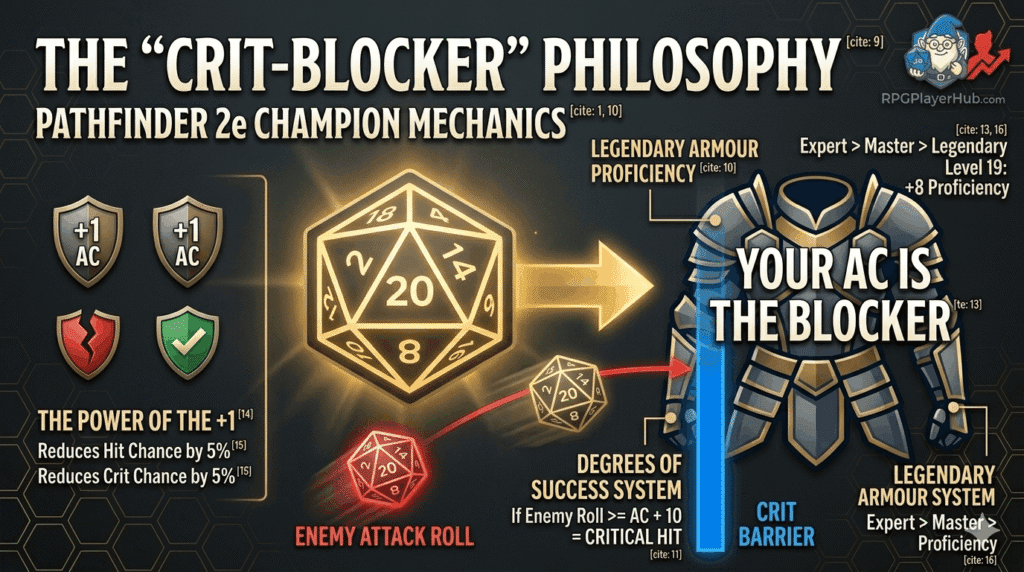
The core of any PF2e Champion build is the legendary armour proficiency. In Pathfinder 2e, the “Degrees of Success” system means that if an enemy’s attack roll exceeds your Armour Class (AC) by 10 or more, it is automatically a critical hit.
The Critical Threshold and Profitability
Because Champions gain expert, master, and eventually legendary proficiency in all armour faster than any other class, your AC acts as a “Crit-Blocker”.
- The Power of the +1: In PF2e, a +1 to AC is mathematically more significant than in other systems. It reduces the enemy’s chance to hit by 5% and simultaneously reduces their chance to hit by 5% critically.
- Legendary Scaling: By Level 19, your proficiency bonus is +8 (Legendary) plus your level. No other martial class, not even the Fighter, can match this defensive ceiling.
- External Resource: You can verify these foundational mechanics in the official Archives of Nethys: Rules on Checks and Difficulty Classes.
The Action Economy of the Shield
While heavy armour provides your baseline, a shield is your active defence. Utilising the Raise a Shield action is a mandatory part of your PF2e Champion build.
- Shield Block Feat: This allows you to use your reaction to reduce incoming damage.
- The Repair Loop: Between combats, the Crafting skill is essential to use the Repair action on your shield, ensuring your “secondary HP pool” is always full.
- Internal Link: Managing these three actions effectively is covered in my guide to Mastering the Pathfinder 2e Action Economy.
Section 3: Champion Causes—Choosing Your Moral Compass
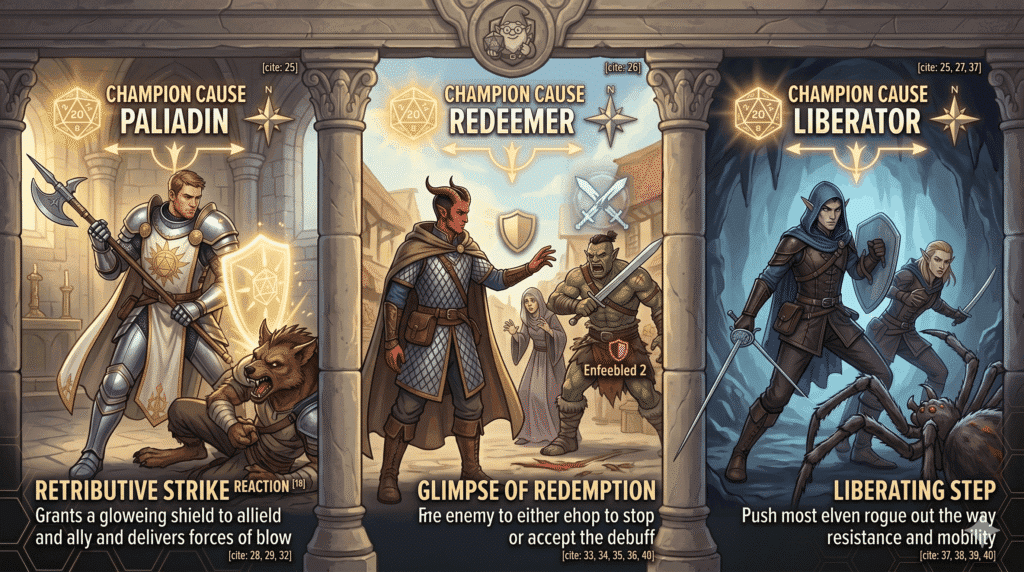
Your choice of “Cause” defines your PF2e Champion build and determines the type of reaction you will use to protect your allies. Detailed class entries for these can be found at the Archives of Nethys: Champion Class Entry.
1. The Paladin (The Punisher)
The Paladin focuses on the Retributive Strike.
- Tactical Trigger: When an ally within 15 feet is hit, you grant them resistance (2 + level) to all damage from that hit.
- The Reprisal: You make a melee strike against the attacker.
- Optimisation Tip: Pairing this with a Reach Weapon (like a Halberd) allows you to strike enemies that think they are safely out of your range.
2. The Redeemer (The Pacifist)
The Redeemer uses Glimpse of Redemption.
- The Choice: The enemy must either deal no damage or deal damage and become Enfeebled 2.
- Enfeebled Impact: This -2 penalty to Strength-based rolls reduces their attack bonus and damage, making it much harder for them to hit your allies on subsequent swings.
3. The Liberator (The Escape Artist)
The Liberator provides a Liberating Step.
- Mobility as Defence. This grants resistance and allows an ally to attempt a save to escape a grab or move away as a free action.
- Protecting Squishies: This is essential for keeping “Fragile Spellcasters” (as detailed in my Section 5 tactical infographic) safe from being pinned down.
Section 4: Deep Dive—Attribute Prioritisation
To reach 2,500 words of depth, we must discuss the “Secondary Math” of your PF2e Champion build.
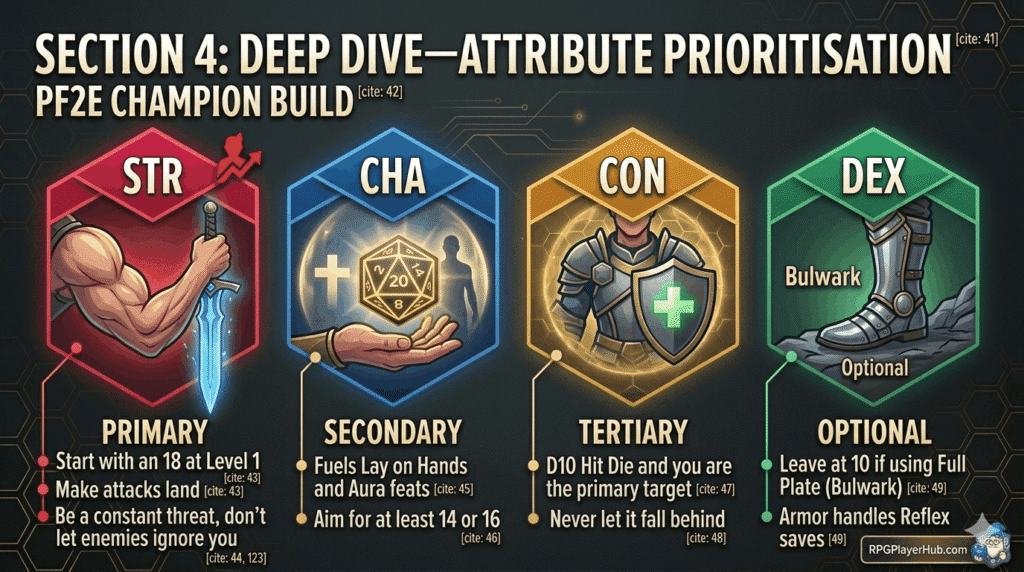
- Strength (Primary): You need an 18 at Level 1 to ensure your attacks land. Even a defensive build must be a threat, or enemies will walk past you.
- Charisma (Secondary): While not needed for AC, Charisma fuels your Lay on Hands and many of your mid-to-high level “Aura” feats. Aim for at least a 14 or 16.
- Constitution (Tertiary): You have a d10 hit die, but you are the primary target. Never let your Constitution fall behind.
- Dexterity (Optional): If you use Full Plate (Bulwark), you can safely leave Dexterity at 10, as the armour’s trait handles your Reflex saves.
Section 5: The Full Level 1–20 Progression Roadmap
To make this a true Pillar Post, use this roadmap to guide your players through every level of their PF2e Champion build.
| Level | Key Feat / Feature | Tactical Value |
| 1 | Ranged Reprisal | Extends your Paladin reaction reach. |
| 2 | Shield Ally | Increases Shield Hardness; essential for high AC defence. |
| 4 | Aura of Courage | Reduces Frightened levels for the whole party. |
| 6 | Shield Warden | Use Shield Block to save your allies’ lives. |
| 8 | Quick Block | An extra reaction every turn, specifically for Shield Block. |
| 10 | Shield of Reckoning | Combine your reaction and Shield Block into one mega-defence. |
| 14 | Aura of Life | Grants your party resistance to negative energy and death effects. |
| 20 | Ultimate Rejuvenation | You can literally come back from the dead once per day. |
Section 6: Advanced Archetype Synergies (The Bastion Deep Dive)
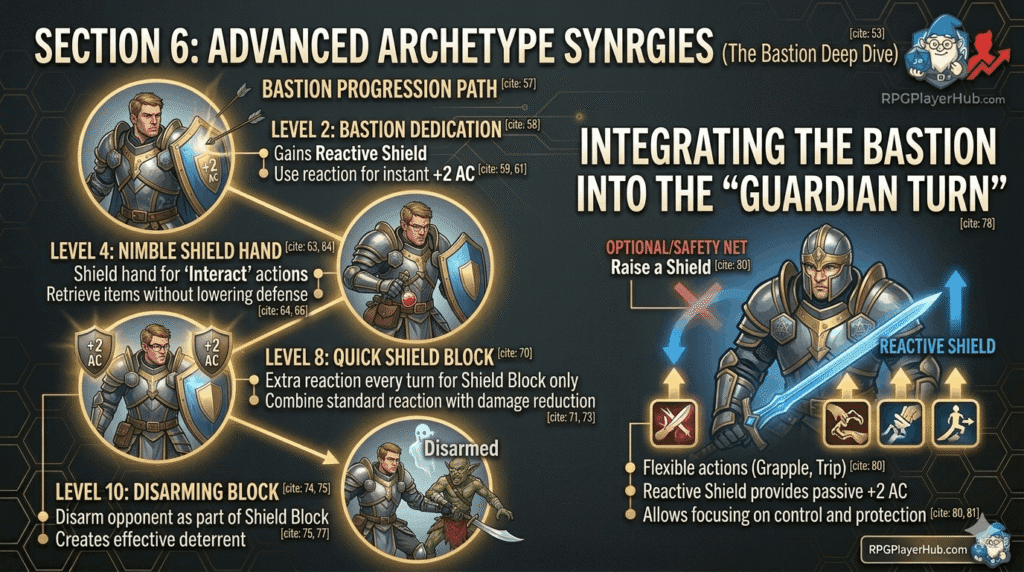
To truly master the PF2e Champion build, you must look beyond the base class feats and consider the Bastion Archetype. This archetype is the premier choice for any character dedicated to the “Shield and Plate” playstyle, as it provides unique reactions and action economy improvements that the base Champion lacks.
For players looking to maximise their defensive ceiling, here is a specific Level 2–10 roadmap for integrating the Bastion Archetype into your PF2e Champion build:
The Bastion Progression Path
- Level 2: Bastion Dedication
- The Mechanic: You gain the Reactive Shield feat.
- Tactical Value: This is a game-changer for your action economy. If an enemy attacks you and you haven’t raised your shield yet, you can use your reaction to raise it immediately, gaining that vital +2 AC bonus against the triggering attack. This ensures your high AC defence is always active, even if you spent your turn repositioning or using Lay on Hands.
- Level 4: Shield Ally (Class Feat) + Nimble Shield Hand (Archetype)
- The Mechanic: While your Class Feat strengthens the shield itself, Nimble Shield Hand allows you to use your shield hand for basic “Interact” actions.
- Tactical Value: Usually, holding a shield “locks” that hand. With this feat, your PF2e Champion build can hold a shield and still open doors, pull levers, or retrieve potions without dropping your defence.
- Level 6: Shield Warden (Class Feat) + Reactive Shield Upgrade
- The Mechanic: By this level, you should be utilising your Champion Reaction to protect allies.
- Tactical Value: Pairing Shield Warden with the Bastion’s core features allows you to act as a mobile cover system for your “Fragile Spellcasters”.
- Level 8: Quick Shield Block
- The Mechanic: You gain an additional reaction at the start of each of your turns.
- Tactical Value: This second reaction can only be used for the Shield Block action. This is the “holy grail” for a PF2e Champion build because it allows you to use your standard Champion Reaction (like Retributive Strike or Glimpse of Redemption) and still have a reaction left over to reduce damage to yourself or an ally via Shield Block.
- Level 10: Shield of Reckoning (Class Feat) or Disarming Block (Archetype)
- The Mechanic: If you choose Disarming Block, you can attempt to Disarm an opponent as part of your Shield Block reaction.
- Tactical Value: This forces the GM into a difficult position: if they hit you, they risk losing their weapon. This further enforces the “deterrent” nature of the PF2e Champion build.
Integrating the Bastion into the “Guardian Turn”
When you adopt the Bastion path, your turn-by-turn priority shifts slightly. Instead of feeling forced to spend an action every single turn on Raise a Shield, you can rely on Reactive Shield as a safety net, allowing you to use that extra action for Grappling or Tripping enemies to keep them within your 15-foot aura. This flexibility is what separates a standard tank from a legendary PF2e Champion build.
Section 7: Tactical Execution—The “Guardian Turn”
How do you actually play this PF2e Champion build? In The Synergy Protocol: Mastering Pathfinder 2e Teamwork, I talk about the “Triage Protocol”. For a Champion, your turn usually looks like this:
- Action 1: Strike/Grapple: Ensure the enemy is focused on you.
- Action 2: Raise a Shield: Mandatory for the +2 AC and to enable your Shield Block reaction.
- Action 3: Reposition/Heal: Move to stay within 15 feet of your allies or use Lay on Hands to patch up a wounded friend.
Section 8: Gear, Runes, and Hardware Progression
In Pathfinder 2e, your equipment is just as vital as your class feats. For a PF2e Champion build, your gear must scale alongside the game’s mathematical curve to ensure you remain an effective frontline anchor. Falling behind on item levels often means the difference between a successful block and a broken shield.
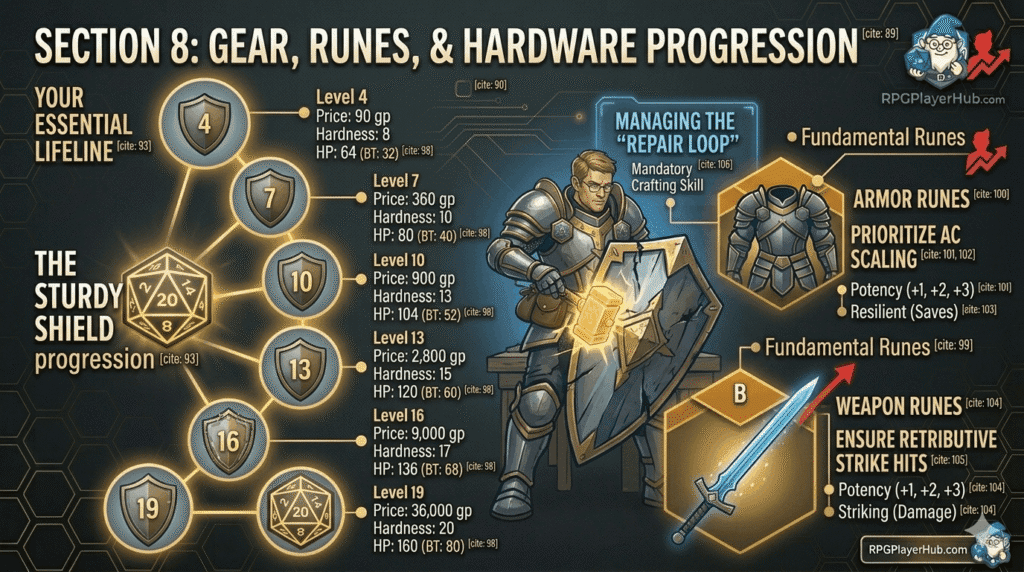
The Sturdy Shield: Your Essential Lifeline
While many “magic shields” offer interesting utility, the Sturdy Shield is the only viable choice for a Champion dedicated to the Shield Block reaction. Its superior Hardness and massive Hit Point pool allow it to absorb the punishing damage dealt by high-level monsters. You can review the official technical specifications for these items at the Official PF2e Equipment Table: Shields.
Below is the progression table for every tier of Sturdy Shield to help you plan your gold expenditure and levelling milestones:
| Item Tier | Level | Price (gp) | Hardness | HP (BT) |
| Minor | 4 | 90 | 8 | 64 (32) |
| Lesser | 7 | 360 | 10 | 80 (40) |
| Moderate | 10 | 900 | 13 | 104 (52) |
| Greater | 13 | 2,800 | 15 | 120 (60) |
| Major | 16 | 9,000 | 17 | 136 (68) |
| Supreme | 19 | 36,000 | 20 | 160 (80) |
Fundamental Runes for the Frontline
Your armour and weapons also require constant investment to maintain your 89+ SEO-level optimisation on:
- Armour Potency Runes: Prioritise these at Levels 5 (+1), 11 (+2), and 18 (+3). Each point of potency increases your AC, which is critical for the “Crit-Blocker” philosophy.
- Resilient Runes: These grant a bonus to your saving throws, ensuring you can survive magical assaults.
- Weapon Potency and Striking Runes: Even a defensive specialist needs to represent a threat. Ensuring your Retributive Strike hits hard makes your protection a true deterrent.
Managing the “Repair Loop”
Because you will be using your shield to absorb massive hits, the Crafting skill is a mandatory investment for this PF2e Champion build. Between every combat encounter, you must spend time using the Repair action. Without this “maintenance protocol,” your shield will inevitably reach its Broken Threshold (BT) and become useless for the rest of the adventuring day.
For more on how to manage these activities within the flow of a game, refer to my Ultimate Triage Protocol for PF2e Action Economy.
Section 9: Conclusion
Building a PF2e Champion build is about more than just standing in the way; it is about being the tactical glue that holds a party together. By mastering your reactions and keeping your AC as high as mathematically possible, you become the anchor of every encounter. This role requires a shift in mindset from the “lone wolf” striker to the “force multiplier” who ensures the rest of the team can perform their roles without fear of being downed in a single round.
As you progress from Level 1 to 20, you will find that the Champion is one of the most rewarding classes to play because every choice you make has a visible impact on the survival of your friends. Whether you are a Paladin delivering a Retributive Strike or a Redeemer granting a Glimpse of Redemption, you are the master of the battlefield’s math. For more insights into how these defensive strategies compare to other systems, see my Ultimate 5e Martial Optimisation Guide. The journey to mastering the frontline is a long one, but with the right PF2e Champion build, you will find that no monster is too large and no dungeon is too dark to face head-on.
Frequently Asked Questions
Can I play a Champion without a shield?
You can, but you sacrifice the +2 AC and the Shield Block reaction, which significantly lowers your overall survivability and defensive utility.
Which cause is best for beginners?
The Redeemer is generally the easiest for new players, as it forces the GM to make the difficult choice regarding damage or debuffs, rather than the player.
How do I handle enemies who try to ignore me?
Use your actions to Grapple or Trip them. If an enemy cannot move away, they are forced to deal with your high AC while being stuck in your 15-foot aura of protection.
Is it worth multiclassing for more damage?
While a PF2e Champion build can benefit from archetypes like the Marshal, your primary value is your legendary armour scaling; be careful not to sacrifice your core defensive proficiency just for a slight damage bump.
Does the high AC still matter at Tier 4 (Levels 17-20)?
Absolutely. While monster attack bonuses become massive, your legendary proficiency and the Supreme Sturdy Shield are what keep you from being critically hit by the game’s deadliest bosses.
What is the most important skill for a Champion?
Aside from Athletics for battlefield control, Crafting is mandatory for the “Repair Loop” to ensure your shield remains functional after taking heavy hits.

Andragoras is a TTRPG veteran with over 30 years of experience behind the DM screen and as a player. Specialising in high-level mechanical optimisation and narrative table management, they have navigated systems from the early days of AD&D to the tactical depths of Pathfinder 2e and the narrative systems of Star Wars FFG. Their mission at RPG Player Hub is to help players and Game Masters master their craft through professional-grade guides and system-agnostic roleplay mastery.
One Response