
Master the Hexblade Warlock build 5e with this complete guide. Covers the best feats (Polearm Master, Great Weapon Master), top Eldritch Invocations, optimal spell selection, the Hexadin and Sorlock multiclass options, and the Advantage Protocol.
Table of Contents
When discussing the most impactful subclasses in Dungeons & Dragons 5th Edition, the Hexblade Warlock build 5e stands alone. Introduced in Xanathar’s Guide to Everything, this patron fundamentally altered the mechanical landscape of the game. Whether you are playing a pure monoclass Warlock or looking for the most potent multiclass dip in the system, the Hexblade is the gold standard for martial spellcasters.
Before the Hexblade, building a melee Warlock — the “Bladelock” — was an exercise in frustration. You needed high Dexterity or Strength to hit your enemies, high Charisma for your spells, and high Constitution to survive in melee. The Hexblade solves this “Gish Dilemma” at level one, allowing you to use your Charisma modifier for attack and damage rolls. This guide breaks down the optimal choices for a pure Hexblade Warlock, from race selection and ability scores to the best feats, invocations, and spell selections, as well as the infamous multiclass options that have dominated tables for years.
The Core Mechanics: Why the Hexblade Dominates
To understand why the Hexblade is so powerful, we must dissect its level one features. In the “Roleplay Mastery” of mechanical optimisation, level one is where the foundation of your entire build is laid. Hex Warrior is the feature that changed the game. You gain proficiency with medium armour, shields, and martial weapons. More importantly, whenever you finish a long rest, you can touch one weapon that lacks the two-handed property. When you attack with that weapon, you can use your Charisma modifier, instead of Strength or Dexterity, for the attack and damage rolls. This single feature makes the Hexblade the most efficient martial caster in 5e.
Hexblade’s Curse is equally transformative. As a bonus action, you curse a target for one minute. You gain a bonus to damage rolls against the cursed target equal to your proficiency bonus. Any attack roll you make against the cursed target is a critical hit on a roll of 19 or 20 on the d20.
Finally, if the cursed target dies, you regain hit points equal to your Warlock level plus your Charisma modifier. This feature scales perfectly from level 1 to 20, providing consistent, resource-free damage and survivability. These two features alone make a one-level dip into Hexblade incredibly tempting for Paladins, Bards, and Sorcerers — but for a pure Hexblade, they are the engine that drives your entire combat strategy.
Ability Score Prioritisation Hexblade Warlock Build 5e
Because of Hex Warrior, your ability score priorities are incredibly straightforward. Charisma is your god-stat — it dictates your weapon accuracy, your weapon damage, your spell save DC, and your spell attack modifier. You want this at 20 as quickly as possible. Constitution is your second priority; you are a melee combatant with a d8 hit die, and you need to maintain concentration on crucial spells like Hex or Shadow of Moil. Aim for at least a 14 or 16. Dexterity only needs to reach 14, because medium armour caps its bonus at +2. Anything higher is wasted. Strength and Intelligence are your dump stats — nothing in this build requires them.
Race Selection: The Best Foundations
While Tasha’s Cauldron of Everything allows you to place racial ability score increases wherever you want, certain races still offer mechanical advantages that synergise perfectly with the Hexblade.
Custom Lineage or Variant Human is the classic optimiser’s choice — starting with a free feat at level one is incredibly powerful, and for a Hexblade, taking Polearm Master right out of the gate puts you significantly ahead of the power curve. Half-Elf is the traditional king of Charisma builds: a +2 to Charisma, two +1s to other stats, and eligibility for the Elven Accuracy feat.
Shadar-Kai offers a free feat and a bonus action teleport that grants resistance to all damage for a turn — an incredible tactical tool for a melee Warlock who needs to engage priority targets or escape a bad position.
The Best Feats for a Hexblade Warlock Build 5e
Feats are where your Hexblade truly comes online. Because you only need to max out one stat — Charisma — you have significantly more room in your build for feats than a traditional martial character.
| Feat | Priority | Why It Works |
|---|---|---|
| Polearm Master | Essential | Grants a bonus action attack with the polearm butt and opportunity attacks when enemies enter reach. Stacks with Hexblade’s Curse proficiency damage on every hit. |
| Great Weapon Master | Essential | The 5/+10 engine. Pairs with advantageous sources (Darkness, Shadow of Moil) to negate the accuracy penalty and deal devastating damage. |
| Elven Accuracy | Elf/Half-Elf Only | Reroll one die when you have advantage using Charisma. Combined with a 19-20 crit range, your critical hit chance becomes extraordinary. |
| War Caster | Sword & Board Builds | Cast spells with hands full, advantage on concentration checks, and cast spells as opportunity attacks. Essential if you prefer a shield over a polearm. |
| Resilient (Con) | Mid-Game | Adds proficiency bonus to Constitution saves. Best taken at level 8+ when proficiency bonus is +3 or higher, as a supplement to War Caster. |
Eldritch Invocations: Customising Your Arsenal
Invocations are what make Warlocks unique — permanent, at-will abilities or passive buffs that define your playstyle. For a melee Hexblade, your choices are largely dictated by the Pact of the Blade.
At level 2, take Agonising Blast for a reliable ranged option and Eldritch Mind for advantage on concentration checks. At level 3, Improved Pact Weapon is essential — it grants your pact weapon a +1 bonus and allows you to summon two-handed weapons like a glaive that benefit from your Charisma modifier.
At level 5, Thirsting Blade is mandatory (your Extra Attack equivalent), and Eldritch Smite allows you to expend a spell slot to deal massive force damage and knock a target prone on a hit — no saving throw. At level 12, Lifedrinker adds your Charisma modifier as bonus necrotic damage on every weapon attack, stacking on top of your existing Charisma-to-damage from Hex Warrior.
Spell Selection: The Hexblade’s Grimoire
Warlocks have very few spell slots, but they recover them on a short rest and always cast at the highest possible level. Your spell selection must therefore focus on high-impact, long-duration spells that define an entire encounter.
Shield and Armour of Agathys are your level 1 staples — Shield is the best defensive spell in the game, and Armour of Agathys at 5th level grants 25 temporary HP and deals 25 cold damage to every attacker. Darkness combined with the Devil’s Sight invocation creates a “blinding bubble” where you have advantage and enemies have disadvantage — one of the most powerful sustained combat states in 5e.
Hypnotic Pattern is your premier area control spell, capable of shutting down half an encounter. Shadow of Moil at level 4 replaces the Darkness combo for most situations — it heavily obscures you, grants the same advantage/disadvantage benefits, and deals necrotic damage to attackers, all without blinding your allies.
The Multiclass Question: Hexadin, Sorlock, and Swords Bard
The Hexblade is infamous for its multiclassing potential because Hex Warrior is front-loaded at level one, making it the most efficient “dip” in the game for Charisma-based classes.
The Hexadin (Paladin/Hexblade) is the most popular combination: a one-level Hexblade dip allows a Paladin to use Charisma for weapon attacks, eliminating the need for high Strength and making the character entirely Single Ability Dependent.
This frees up ASIs for feats and maximises the Paladin’s Aura of Protection, spell save DC, and melee accuracy simultaneously. The Sorlock (Sorcerer/Hexblade) uses a two-level dip to give a Sorcerer medium armour, shields, the Shield spell, and Eldritch Blast with Agonising Blast — transforming a squishy caster into a durable artillery platform.
As discussed in our Melee Bard guide, a one-level Hexblade dip also solves the Bard’s Gish Dilemma by providing shield proficiency and Charisma-based weapon attacks. The Swords Bard/Hexblade combination is one of the most flavourful and mechanically sound builds in the game.
The “Advantage Protocol”: Putting It All Together
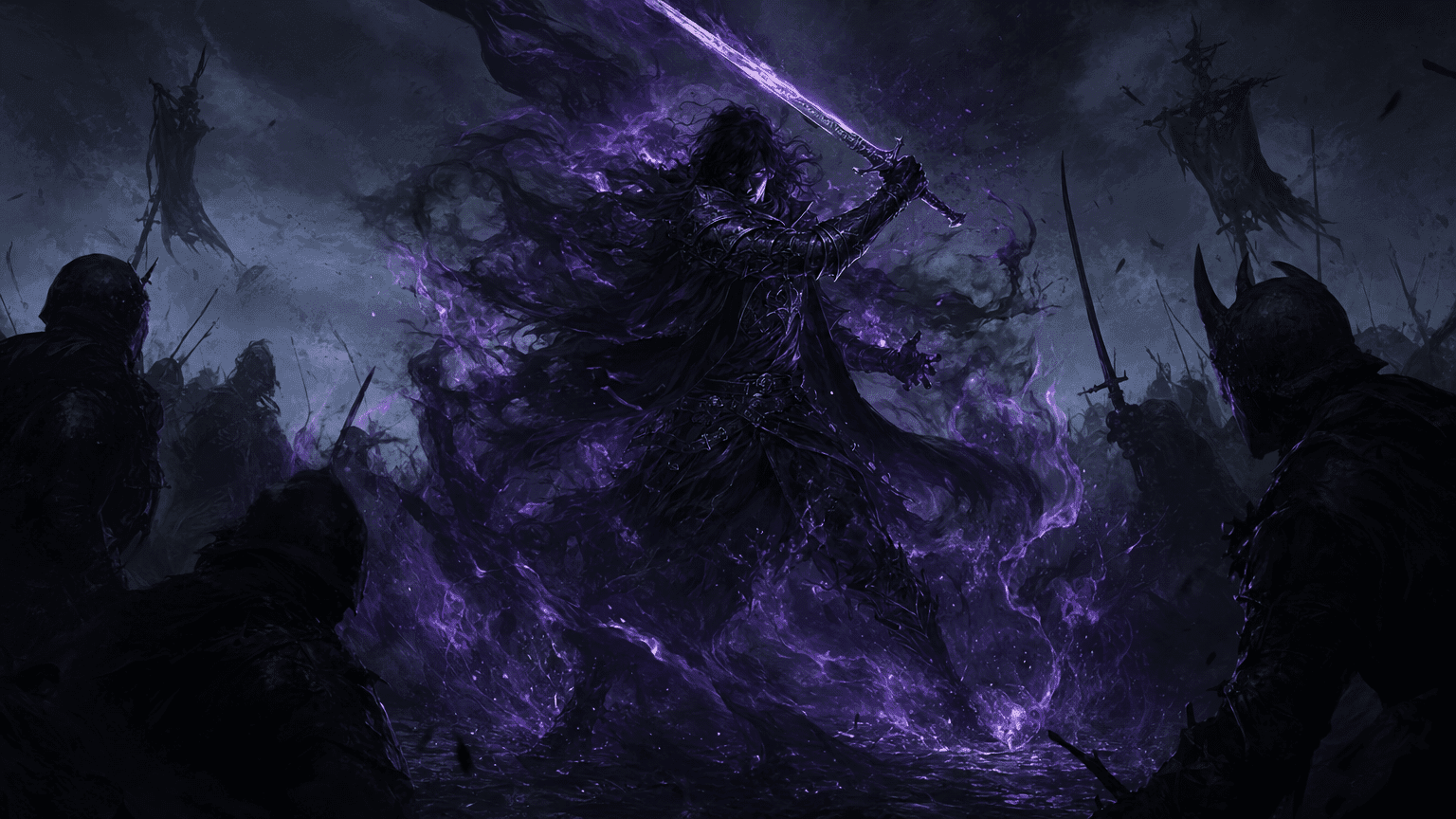
To truly master the Hexblade Warlock build 5e, you must understand how all these pieces fit together in actual play. The Advantage Protocol is the name for the combat loop that makes this build so dominant: establish advantage, activate Hexblade’s Curse, and then attack with Great Weapon Master active. Every element of the build feeds into this loop. The official D&D Beyond Hexblade page confirms that Hexblade’s Curse is one of the most powerful level-one subclass features in the game.
On Turn 1, apply Hexblade’s Curse as a bonus action, then cast your premier buff spell — usually Shadow of Moil — as your action. You are now heavily obscured: attacks against you have disadvantage, and your attacks have advantage.
On Turn 2, move into melee and declare your Great Weapon Master attacks. Because you have an advantage, the -5 penalty is mathematically negated. You make two attacks with your main weapon (via Thirsting Blade) and one bonus action attack with the polearm butt (via Polearm Master). Every attack benefits from the +10 GWM damage and the proficiency bonus damage from Hexblade’s Curse.
The critical strike is where the build reaches its peak. Because you have advantage and crit on a 19 or 20 — or on a 19, 20 with three dice if you have Elven Accuracy — your chance of scoring a critical hit on your turn is extraordinary.
When you roll that natural 19 or 20, you declare an Eldritch Smite. You double the weapon dice, you double the force damage from the smite, and you knock the target prone, granting you advantage on any remaining attacks even if your concentration drops. This is the true power of the Hexblade: it is not just a collection of strong features, but a synergistic engine that turns a d8 spellcaster into the most lethal martial combatant on the battlefield.
The “Trap” Options: What to Avoid
Just as important as knowing what to take is knowing what to avoid. Without Pact of the Blade, you cannot use your Charisma modifier for melee attacks — so never skip it. The most common mistake players make with the Hexblade Warlock build 5e is investing in Strength or Dexterity early, wasting precious ASIs that should go toward Charisma or feats.
Dual-wielding is a common fantasy that fails in practice: your bonus action is already claimed by Hexblade’s Curse, moving Hex, or the Polearm Master attack, and the Hex Warrior feature only applies to one weapon at a time.
Witch Bolt requires your action every turn to maintain, preventing you from attacking. Hellish Rebuke uses your reaction, which is better saved for the Shield spell. Neither spell scales well enough to justify a high-level Warlock slot in the mid-to-late game. Finally, Tough is a trap for casters — maintaining a Hypnotic Pattern will save you far more effective HP than the Tough feat provides. Resilient (Con) is almost always the better choice.
Feat Progression Path (Level 1–20)
| Level | Priority Choice | Strategic Reasoning |
|---|---|---|
| 1 (Variant Human / Custom Lineage) | Polearm Master | Start generating bonus action attacks immediately. Hexblade’s Curse proficiency damage applies to every hit from turn one. |
| 4 | Charisma ASI (16 → 18) | Accuracy and damage are paramount. Push Charisma to 18 before taking additional feats. |
| 8 | Great Weapon Master | By now, you have Thirsting Blade and a reliable advantage source. The 5/+10 engine comes fully online. |
| 12 | Charisma ASI (18 → 20) | Max out Charisma. Lifedrinker now adds +5 necrotic damage to every attack on top of your existing Charisma-to-damage. |
| 16 | Resilient (Con) or War Caster | Shore up your concentration saves for the end-game tier, where monster DCs regularly hit 17+. |
| 19 | Elven Accuracy (if eligible) or Tough | The final power spike. Elven Accuracy turns your already-high crit chance into a near-certainty on any turn with advantage. |
The Ultimate Hexblade Warlock Build 5e

Andragoras is a TTRPG veteran with over 30 years of experience behind the DM screen and as a player. Specialising in high-level mechanical optimisation and narrative table management, they have navigated systems from the early days of AD&D to the tactical depths of Pathfinder 2e and the narrative systems of Star Wars FFG. Their mission at RPG Player Hub is to help players and Game Masters master their craft through professional-grade guides and system-agnostic roleplay mastery.
One Response