
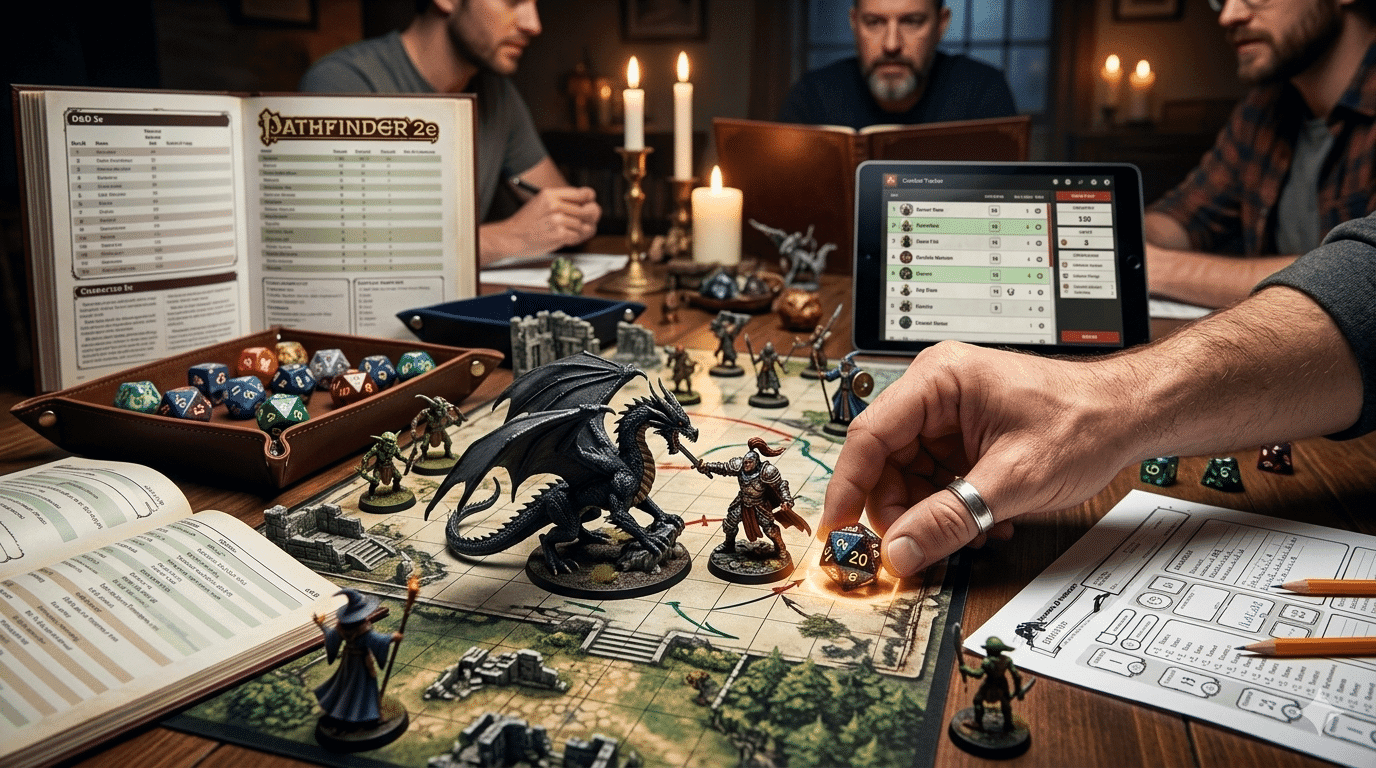
The Combat Momentum Protocol is a high-level TTRPG management framework designed to eliminate analysis paralysis and maintain narrative tension. By focusing on mechanical optimization and professional-grade table management, the protocol ensures that tactical depth across systems like D&D 5e, Pathfinder 2e, and Star Wars FFG does not come at the cost of pacing.
Table of Contents
The Hidden Killer of Campaigns: The “Turn-Grind”
In 30 years of running games, I’ve realised that the most dangerous monster isn’t a Great Red Dragon or a Sith Inquisitor—it’s the ten-minute silence while a player flips through a Rulebook.
When combat stalls, the “Mental Load” on the Game Master triples. Instead of describing the spray of ichor or the sizzle of a lightsaber, the GM becomes a human calculator, trying to keep the table’s energy from bottoming out. Combat should be the most high-stakes roleplaying you do.
To keep it that way, we have to treat our mechanical speed as a form of respect for everyone else’s time.
Pillar 1: The Pre-Calculation Protocol
The Pre-Calculation Protocol eliminates the ‘Math Pause’ by requiring players to calculate all static modifiers and spell effects before their turn begins.
The “Math Pause” is the primary momentum killer. To combat this, you must adopt a “Real-Time Strategy” mindset. Your turn should start with a declaration, not a question.
The System-Specific Speed Hacks:
- D&D 5e: Move away from “Wait and See.” Use the Always Be Rolling rule. Calculate your attack bonuses and static damage modifiers before your turn. If you’re a spellcaster, have the spell text open and ready—never ask the DM, “What’s the save DC on this again?”
- Pathfinder 2e: Because of the tight math, every +1 matters. Keep a “cheat sheet” of your most common buffs (like Inspire Courage or Bless). Don’t calculate the math mid-swing; know your “Modified Total” for a buffed vs. unbuffed state.
- Star Wars FFG: Narrative dice require interpretation. Pre-build your Positive Pool (Green Ability and Yellow Proficiency dice). When the GM calls on you, you only need to add the Purple Difficulty dice. This shaves 60 seconds off every roll.
Pre-building your positive pool is a core component of the [Star Wars FFG Advantage Protocol] for narrative dice.
Pillar 2: The “Three-Option” Triage
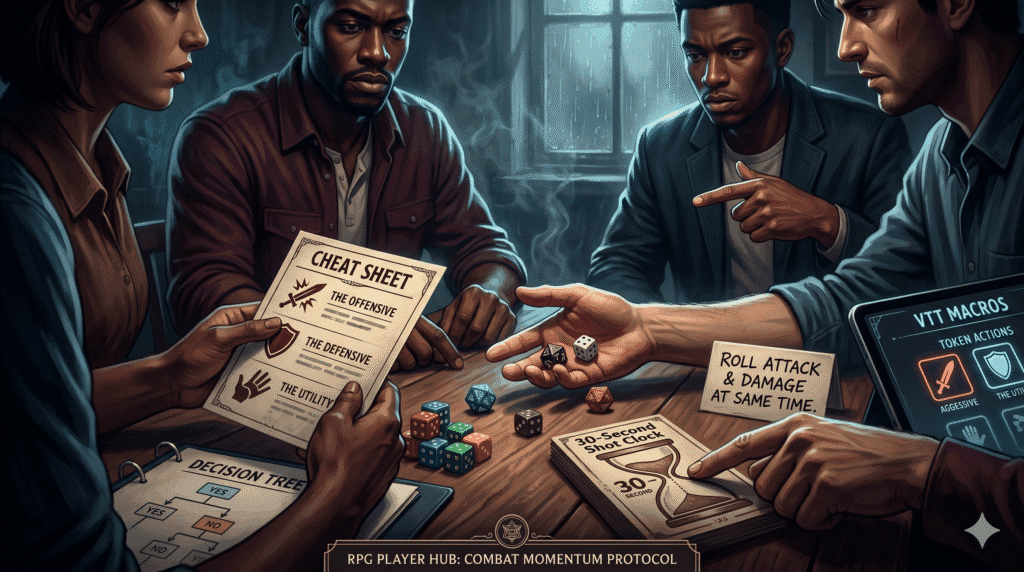
The Three-Option Triage prevents analysis paralysis by having players maintain three ‘Ready States’—Offensive, Defensive, and Utility—ensuring a default action is always available regardless of battlefield shifts.
The combat momentum protocol is built on three pillars of player discipline. Analysis Paralysis happens when players look for the “perfect” move in a battlefield that changes every few seconds. By the time your turn arrives, your original plan is likely obsolete.
Instead of one plan, maintain three Ready States, Combat Momentum Protocol:
- The Offensive: Your primary damage combo (e.g., Extra Attack, Power Attack, or Autofire).
- The Defensive: Your “Panic Button.” If you get flanked or dropped to low HP, don’t panic. Have a default defensive move—Raising a Shield (PF2e), the Dodge Action (5e), or Taking Cover (FFG).
- The Utility: A move that sets up an ally. If you can’t hit the high-AC boss, use an action to Help, Demoralise, or Aim.
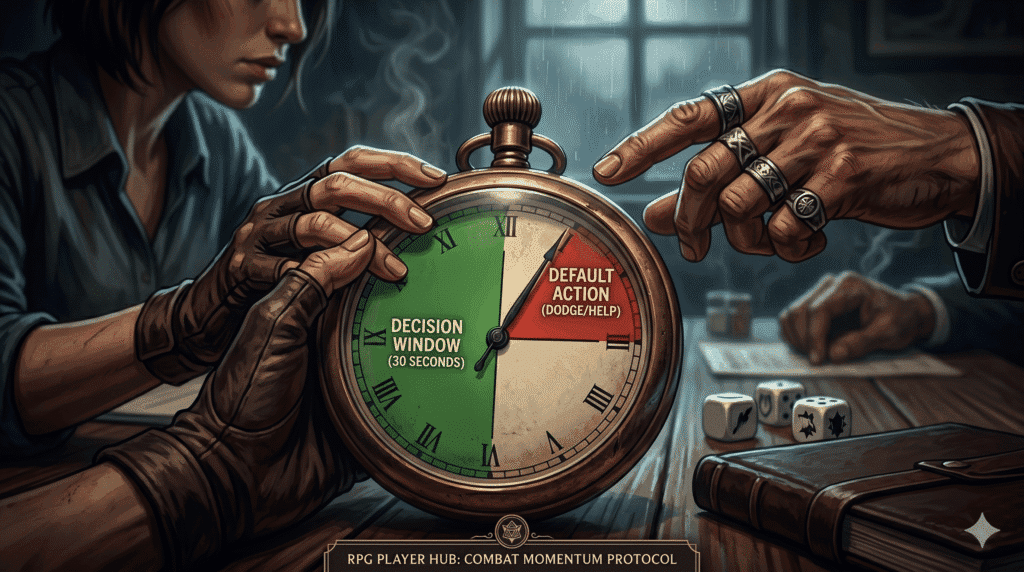
The 30-Second Shot Clock: If the battlefield shifts and you’re disoriented, give yourself 30 seconds to find an opening. Suppose you can’t, default to your Defensive or Utility option. A “good” fast turn is always better for the table than a “perfect” slow one.
Pillar 3: Narrative Bridging (The Hand-Off)
Etiquette doesn’t end when the dice stop rolling. Most players “Dead-End” their turns: “I hit for 12. I’m done.” This creates a vacuum of silence that the GM has to fill.
Instead, use Narrative Bridging. Start your turn by acknowledging the previous player and end it by “passing the torch” to the next.
- Example: “As the Fighter finishes his swing, I slide into the opening he created, casting Firebolt for 14 damage! [Next Player], the creature is reeling—finish it!”
By naming the next player “On Deck,” you act as a Co-GM, maintaining the cinematic flow without the DM having to nag anyone.
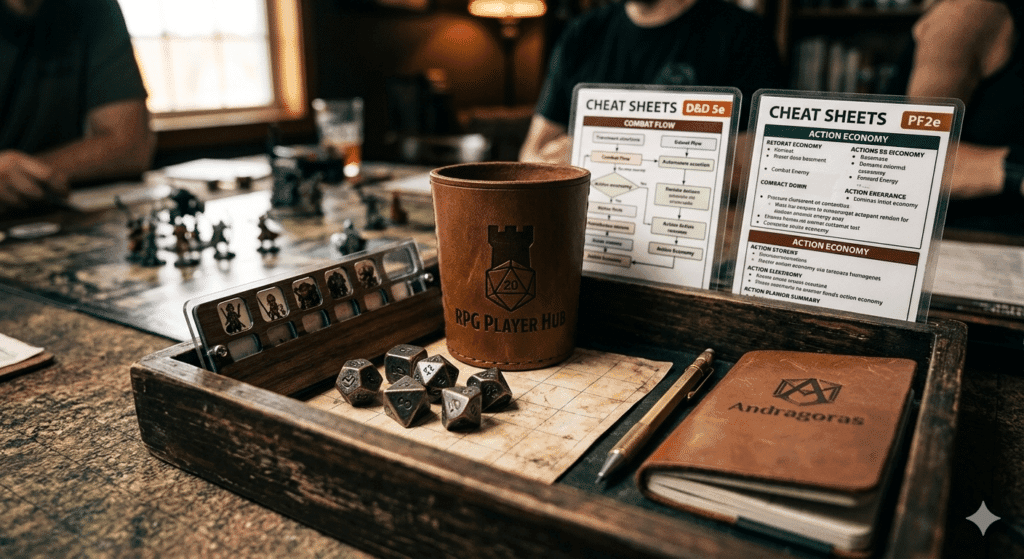
The Veteran’s Toolbox: Physical vs. Digital Speed
Optimisation isn’t just mental; it’s physical.
- At the Physical Table: Use colour-coded dice. Roll your d20 and damage dice at the same time. If they hit, the math is already there. If they miss, you ignore the damage dice.
- On the VTT (Roll20/Foundry): Macros are your best friend. If you have to click through three sub-menus to find your Searing Smite, you’re breaking the protocol. Set up “Token Actions” for your top 3 moves so they are always one click away.
The Psychology of the “Math Pause”
Before we dive into the mechanical solutions, we need to understand why the “Math Pause” happens in the first place. It is rarely the case of a player not knowing the rules. More often, it is a symptom of Option Paralysis combined with a fear of making a sub-optimal choice.
In modern TTRPGs, especially crunch-heavy systems like Pathfinder 2e or high-level D&D 5e, a single turn can involve moving through difficult terrain, triggering an attack of opportunity, calculating a spell save DC, and applying three different conditional modifiers. When a player is suddenly put on the spot, the brain naturally freezes. They want to make the “best” move, but the sheer volume of variables makes calculating that move impossible in real-time.
This mental freeze is similar to the [Investigative Resilience Protocol] used in horror settings to manage high-stress player decisions.
This is why the combat momentum protocol is not just about doing math faster; it is about fundamentally changing how you approach your turn. You are not a computer trying to solve an equation; you are a character in a life-or-death situation reacting on instinct. The protocol gives you the framework to trust those instincts.
Pillar 4: The “Fail Forward” Philosophy
While the first three pillars focus on what you do before and during your turn, the fourth pillar focuses on what happens when things go wrong. A missed attack or a failed saving throw is often treated as a dead end, bringing the narrative momentum to a screeching halt.
To truly master the Combat Momentum Protocol, you must embrace the “Fail Forward” Philosophy.
When you miss that crucial strike, do not just say, “I rolled a 4. I miss.” That kills the energy in the room. Instead, narrate the failure in a way that raises the stakes or changes the environment.
“I swing my greataxe with everything I have, but the Orc Warlord catches the haft with his bare hand, grinning through his tusks. I’m overextended and wide open.”
By narrating your failure as a complication rather than a dead end, you maintain the cinematic tension. You give the GM something to work with, and you give the next player a dramatic situation to react to. This is the essence of narrative momentum—the story is always moving forward, regardless of what the dice say.
The GM’s Role in Maintaining Momentum
The Combat Momentum Protocol is primarily a player-facing framework, but the Game Master plays a crucial role in facilitating it. A GM can easily sabotage the protocol by bogging down the game with unnecessary rolls or overly complex environmental hazards. Here are three ways GMs can actively support the protocol at the table.
- Use Static Damage for Minions: If you are running a combat with eight goblins, do not roll damage for every single hit. Use the average damage listed in the stat block. This saves countless minutes over the course of a session.
- Group Initiative for Enemies: Roll initiative once for all identical enemies. Having all the goblins act on initiative count 14 is much faster than tracking eight separate turns.
- Reward Fast Turns: If a player executes their turn flawlessly within 30 seconds, reward them. Give them a point of Inspiration (5e), a Hero Point (PF2e), or a Boost die (FFG) on their next roll. Positive reinforcement is the fastest way to build good habits at the table.
Troubleshooting the Protocol
Implementing the Combat Momentum Protocol will not happen overnight. You will encounter resistance, especially from players who are used to taking their time. Here is how to handle the three most common roadblocks.
- The “Rule Lawyer” Player: This player wants to pause the game to look up the exact wording of a spell or ability. The Fix: Implement a “Ruling Now, Rules Later” policy. The GM makes a quick, fair ruling in the moment to keep the game moving, and the actual rule is looked up during the next break.
- The “Distracted” Player: This player is on their phone or zoning out until their turn comes up, at which point they need a full recap of the battlefield. The Fix: Use the “On Deck” system from Pillar 3 aggressively. When you finish your turn, explicitly call out the distracted player: “[Player Name], you’re up next—what are you doing?”
- The “Overwhelmed” New Player: A new player might find the 30-second shot clock intimidating. The Fix: Pair them with a veteran player who can act as their “Combat Coach,” helping them pre-calculate their modifiers and select their Three-Option Triage between sessions.
The “Decision Tree” Method for Complex Classes
One of the most common pushbacks I hear against the Combat Momentum Protocol is: “But Andragoras, I play a high-level Wizard or Druid! I have too many spells to just pick three options!” This is a valid concern. Full spellcasters inherently carry a heavier mental load than martial classes. However, this is exactly why spellcasters need the protocol more than anyone else. The solution for complex classes is not to abandon the Three-Option Triage, but to evolve it into a “Decision Tree.”
A Decision Tree is a pre-planned flowchart that dictates your actions based on the current state of the battlefield. Instead of looking at your entire spell list every turn, you look at the board state and follow the tree. Let us use a level 9 D&D 5e Wizard as an example. Their Decision Tree begins with a single question: is the Wizard currently concentrating on a high-value spell like Wall of Force or Polymorph? If yes, the primary goal is to protect that concentration — the action becomes casting a non-concentration spell or simply taking the Dodge action. If no, the next question is whether three or more enemies are clustered together. If yes, cast an Area of Effect control spell like Hypnotic Pattern or Slow. If no, default to the most efficient damage cantrip available.
By building this Decision Tree before the session begins, the Wizard player eliminates the need to evaluate all 14 of their prepared spells every round. They simply look at the board, answer two or three yes/no questions, and execute the corresponding action. This reduces a potential five-minute agonising decision into a crisp, 15-second turn. The Decision Tree is not a crutch — it is the same kind of pre-game preparation that separates a professional athlete from an amateur. You are not removing creativity from your play; you are removing indecision.
Managing Summons and Companions Without Stalling
If there is one mechanic that strikes fear into the heart of a Game Master trying to maintain combat momentum, it is the summoning spell. Whether it is a Druid casting Conjure Animals to summon eight wolves, a Necromancer animating a horde of skeletons, or a Beast Master Ranger managing their companion, multiple bodies on the board exponentially increase the “Turn-Grind.” To keep the Combat Momentum Protocol intact while playing a summoner, you must adhere to the “Swarm Rules” of table etiquette.
First, never roll individual attacks for mass summons. If you have eight wolves attacking a single target, do not roll eight d20s one by one. Instead, use a digital dice roller to roll all eight simultaneously, or use the Mob Attacks table found in the Dungeon Master’s Guide (page 250). This table mathematically determines how many attacks hit based on the target’s AC and the attackers’ hit bonus, completely bypassing the need to roll dice individually. Second, group your summons’ initiative with your own — do not force the GM to track a separate initiative count for your skeletons. They act immediately after you do, keeping your entire mechanical footprint contained within a single block of time.
Third, and most importantly, pre-calculate average damage. Just as GMs should use static damage for minions, players should use static damage for their summons. If a wolf deals 2d4 + 2 damage, do not roll the d4s — just declare 7 damage per hit. When eight wolves hit, you instantly know it is 56 damage. The time saved by not counting pips on 16 four-sided dice is immense, and the mathematical average is identical over the course of a campaign. A summoner who follows these three rules can manage an army of creatures in the same time it takes a Fighter to resolve a single Extra Attack.
The Role of the “Combat Caller”
While the GM is the ultimate arbiter of the game, they are often too busy managing monster tactics, tracking hit points, and remembering legendary actions to effectively police the Combat Momentum Protocol. This is where the “Combat Caller” comes in. The Combat Caller is a player who volunteers to assist the GM with the administrative overhead of combat. This is not an in-game role; it is a meta-game responsibility that can transform the pace of your sessions overnight.
The Combat Caller has three primary duties. First, they track initiative — maintaining a visible initiative tracker (whether a physical whiteboard or a digital list) and announcing the turn order. They are the one who says, “Rogue, you are up. Cleric, you are On Deck.” Second, they manage conditions. When a player starts their turn, the Caller reminds them of relevant effects: “Remember, you have advantage from the Faerie Fire, but you take 1d4 poison damage at the start of your turn.” Third, they enforce the Shot Clock. If a player is hesitating, the Caller gently but firmly reminds them of the 30-second rule: “We need a decision, Fighter — are you attacking the Orc or taking the Dodge action?”
Having a player handle these tasks is transformative. It offloads a massive amount of mental bandwidth from the GM, allowing them to focus entirely on narrating the combat and playing the monsters optimally. It also creates a sense of shared responsibility among the players. When a peer is enforcing the pace rather than the GM, it feels less like a teacher scolding a student and more like a team working together to achieve a common goal. If you are the most experienced player at your table, I strongly encourage you to volunteer as the Combat Caller for your next session. You will be astounded by how much faster and more engaging the combat becomes when the GM is freed from the burden of administrative nagging. This single change has, in my experience, done more to improve table pacing than any other single technique in the entire protocol.
Combat Momentum Protocol (FAQ)
How do I apply the Combat Momentum Protocol in Star Wars FFG?
In the Star Wars FFG system, momentum is maintained by pre-calculating common “Advantage” and “Threat” spends. This prevents the narrative flow from stalling during the interpretation of the Narrative Dice System. (Universal/Roleplay Mastery)
Is this protocol compatible with Pathfinder 2e’s Three-Action Economy?
Yes. For Pathfinder 2e, the protocol emphasises “Decision Trees” for the third action, ensuring players have a default narrative or mechanical contribution ready if their primary strike or spell fails. (System-Specific: PF2e)
What is the best way to track initiative to maintain momentum in D&D 5e?
In D&D 5e, utilising “On-Deck” notifications and visible initiative trackers are core components of the protocol’s table management pillar, reducing transition time between player turns. (System-Specific: 5e)
Conclusion: The Combat Momentum Protocol
After 30 years at the table, I’ve realised the most powerful character isn’t the one with the highest DPS—it’s the player who makes the game feel like an epic movie.
When you master the Combat Momentum Protocol, you aren’t just playing faster; you’re playing better. If you’re looking to try a new system with fast, narrative-driven combat, read our guide to Blades in the Dark character creation.

Andragoras is a TTRPG veteran with over 30 years of experience behind the DM screen and as a player. Specialising in high-level mechanical optimisation and narrative table management, they have navigated systems from the early days of AD&D to the tactical depths of Pathfinder 2e and the narrative systems of Star Wars FFG. Their mission at RPG Player Hub is to help players and Game Masters master their craft through professional-grade guides and system-agnostic roleplay mastery.
3 responses